Be well. Practice big medicine.

See Hal Newman’s profile on LinkedIn

Norm Rooker | Cat Wrangling (Part 1)

Posted by on Feb 3, 2012 in Norm Rooker

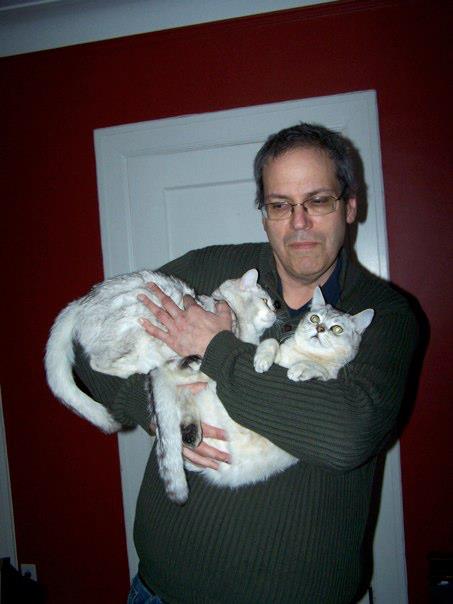
Big Med editor Hal Newman trying to herd Jack & Johnny into his arms

It’s snowing again just a couple of hours before Vicki, my bride of 28 years & sister paramedic are about to hit the road for a weekend getaway.  No big deal, we live in the mountains of southwestern Colorado and knew snow was part of the package when we relocated here seven years ago.

But as I loaded the truck and prepared to head out, after all, that’s why we have 4-wheel drive, I started to flash back to a drive under similar conditions two winters ago.  What follows is not an EMS war story but rather a couple’s tale of solving a problem and working through each other’s “contrasting” working styles & thought processes.

It was the winter of 2010 when my bride and I discovered a new “couples” exercise. Catching your sister-in-law’s cat. Nothing leads to close communication and cooperation like trying to catch a near feral and motivated cat!

It all began innocently enough. We had agreed to cat sit Vicki’s sister Katie’s cat, Eartha.  Katie’s apartment at that time was up on top of Log Hill Mesa and access from the south is by CR 1. County Road 1, aka “the luge”, is a twisty, winding, switch back with spectacular views and drop offs and can be a bit of dicey drive in the winter. With this in mind we opted to bring Eartha to our apartment rather than make a daily drive up the escarpment to Katie’s place.

After all, how hard could that be?

It had been snowing all night and when we set off in the morning there was seven inches of freshly and still falling snow on the ground.  Fortunately the plows had already been down the escarpment a couple of times and you could see the charcoal dust on the road underneath the gauze like layer that was building up from the still continuing to fall snow.  We made it up with a minimum of drama.  Thank goodness for four wheel drive.

Eartha is not an antisocial cat.  It’s not like she hisses and claws at you if you approach her.  It’s just that she prefers to hide in seclusion. So after gathering up her stuff, litter box, kibble, feeders, favorite blankets and what not and making multiple trips through the now eight inches of fresh snow to load them into Vic’s jeep, the real work began.

Think cartoon character Elmer Fudd, “Be berrrrrryyyyy qwiet. We’re hunting puddy tats.”

After discovering that the lump under the bed quilt that Vicki had identified as Eartha was a pillow, the hunt really began. After seven-plus minutes of moving things around and crawling on the floor to peer under chairs, sofas and the bed I made a note to myself.

Don’t wear black polar fleece when you have to crawl around on the floor. You become a human dust mop.

To set the stage, Katie’s apartment is a converted basement area.  One large room with doors off only to the kitchen and bathroom/laundry area.  The room is divided into sections by the strategic placement of portable closet/wardrobe/storage units.  These provided plenty of cat sized places to hide or move to other sections of the apartment where humans had to walk around these same obstacles/walls.

After what seemed like several minutes of scouting around on all fours I spotted movement out of the corner of my eye and tracked it down to said cat staring, not glaring, at me from under the far corner of the bed.

Stretching out on the floor along one side of the bed to block Eartha’s escape, I sent Vicki to the other side to flush the cat out. Vicki stated that during previous efforts to assist Katie in capturing Eartha they used a broom to do this.  With that she got down on all fours and flushed said feline towards me.

I got her but couldn’t get a firm enough grip before she wriggled free and dashed into the next room. Actually ran under one of the portable closets, one of those “some assembly required” affairs of wire poles and vinyl siding, that served as a room divider/wall.

Thus began a 10 minute game of rearranging furniture, blocking kitty escape routes w pillows, and chasing Eartha under the bed and then flushing her out to lose her  yet again. On the third time, me snorting from the many cat hairs & dust bunnies (those few that weren’t already sticking to my polar fleece pants) that have flown up my nostrils I discovered Eartha had gone back under the bed but this time up into the box springs.

All I could see were a few tufts of fur, two legs and a tail hanging down.  Fortunately it was close to one side of the bed. So, I had Vicki lay down on the far side of the bed to block the cat’s escape. My mistake was letting Vicki take the broom with her for a feeling of safety or protection.

I very quietly laid down and was just starting to reach under to grab the cat when Vicki decided to” help” me by pushing the broom at Eartha.  This “helpful” action spurred Eartha to crawl away from the end of the broom stick, and more importantly, me, through the box spring and out of my reach before hopping down and running away.

I “thanked” my bride for her “help” with much glowing and “appreciative” phraseology.  All the time she is laughing and begging me to stop as she needs to pee.  Well that and with her bad knees, she was also asking me to help her up.

We chased Eartha again back to the bedroom and this time she hopped on top of the bed and attempted to hide under the covers. We pulled them back and I think it was less my blazing fast hand speed that caught her by the scruff of the neck than that she just gave up.

She just stared up at us with this baleful look that seemed to say “OK, you’re going to keep chasing me till you catch me so just do it.” At least that was my interpretation of it.

I’m about to turn and tease Vicki all over again about how helpful she was with that broom when she uttered one of those spouse phrases that just stops you dead in your tracks.

“Well that was easier and took less time than I thought it would.”

“Really? Really! Was there something about this “hunt” that maybe you could have shared with me before we started?”

I couldn’t hold the glare for more than a couple of seconds and we both chuckled and loaded Eartha into the jeep for the descent down to the apartment.

As we crept back down the slick escarpment with the slightly pitiful sounds of a now softly mewling Eartha in the background it was at that moment that I decided that cat catching would probably make a good couple’s communication & team building exercise.

Read More

Norm Rooker’s The Hammer & The Spoon

Posted by on Sep 7, 2011 in Norm Rooker

Intro from Hal: Norm Rooker’s been away from these pages for far too long. He’s back with this classic whitewater ride down the stream-of-consciousness.

When Norm reminisces about his early days it primes my own memory machine. So, here’s one that many of my colleagues like to dredge up each time we get together for a beer.

Back when I was a rookie paramedic, many moons ago, in the very fledgling days of full ALS prehospital care we rolled on a call for a cardiac arrest in a church. And not just any church. It was St Joseph’s Oratory – a great basilica with a giant copper dome reminiscent of St Peter’s in Rome.

We were in the midst of coding the patient right there in the pews when a priest approached and asked for the patient’s name. Not realizing he wanted to lead other parishioners in prayer, I was a bit too quick and far too loud with my response, “He ain’t yours yet, Father.”

That line has resonated for more than three decades and I suspect it still has a long ways to go before it finally fades into the background noise of a life spent in EMS.

Find a comfortable chair, prepare a mug of good coffee and enjoy some vintage Norm Rooker.

Norm Rooker’s The Hammer & The Spoon:

Last July Vicki & I drove back to California to attend the wedding of the son of my former EMS partner and best friend, Mike Whooley. Mike was officiating the wedding, having become an “ordained” minister for $42 for a religion that shall remain nameless. However, it was legal for him to perform wedding ceremonies and he was doing it for his son Jon and soon to be daughter-in-law Isabella.

Knowing Mike as well as I did and his sense of humor, I half expected a revival style religious ceremony complete with two costume changes, a gospel choir and possibly a couple of rattlesnakes to boot. However we all have mothers and Mike’s had “re-established” her own rapport with him and made it known that her grandson’s wedding would be short, sweet and calm. I guess Mike also had his own understanding of “Mama Mad”. [see http://bigmedicine.ca/wordpress/2008/06/mama-mad]

The outdoor wedding at a former Boy Scout camp in Mendocino County was well done, nicely moving and under 20 minutes. Even with a last minute stall and need for parental navigational guidence by one of the flower girls.

The reception afterwards was also enjoyable and a chance for Vicki and I to catch up with Mike and another long time medic friend, Hans Enz and his wife Pam. After catching up with each others’ lives, the stories began to flow, some of them a bit embarrassing. Like being reminded that I had had a policy named after me almost three decades ago.

Having a policy named after you is rarely a good thing. I was driving into work, in uniform and happened onto a horrific rollover traffic accident right at the city limits. Actually it had begun in San Mateo County but the momentum and kinetics carried the vehicle and tossed the patient into San Francisco’s city limits.

Back then we all carried our own personal jumpkits. I had developed the habit of keeping mine in my vehicle as I had low seniority and was frequently detailed to different units. I got out, treated the patient, who was in full arrest with CPR being performed by a trio of vacationing MDs and a vacationing Iowa EMT.

There were also about 30-40 bystanders milling around on a 4 lane highway with traffic still whizzing by in the three open lanes. The patient, a young lady who appeared to be in her early 20’s had several laundry baskets filled with children’s clothing and an empty car seat in her vehicle.

I quickly organized the bystanders into a search line and had them do a line sweep along the side of the highway to make sure we didn’t have a second patient. This not only ensured that we had all the patients but also got everyone off of the freeway.

I then pulled my jumpkit from my car, intubated the patient and started a line. When the ambulance arrived to transport the patient I gave a quick handoff report. While the crew packaged and loaded the patient I filled out the intubation paperwork we had to submit as a separate form back then and sent it in with them to the hospital.

Later there was a fuss about an “off duty” paramedic carrying ALS equipment. Fortunately I was exonerated in the investigation and even commended for stepping up and doing the right thing and a good job. However the “Norm Rooker Intubation Policy” was created that stated that no ALS equipment, IVs, medication or intubation equipment was to leave the ambulances or stations.

I was also reminded in that medic tough love way that I had been known from time to time, to well, push the edge of the envelope, so to speak. As an inquisitive young man I learned at an early age that no, while it may frequently also remain as the end point, was just the opening position or negotiating point. This knowledge/belief allowed me to have some great adventures and experiences growing up and served me well as a young EMT and later medic as well as a field supervisor and later an EMS Chief.

Like the time back in 1995 when Vicki and I were attending the EMS TODAY Conference in Orlando, Florida and ended up having quite the adventure at Cape Kennedy. (I know, technically it is Cape Canaveral and the Kennedy Space Port but for those of us from a certain generation who grew up with the space race, it will always be Cape Kennedy.)

Anyway, two years previously Mike & I had attended the National Association for Search And Rescue’s annual conference in St. Petersburg, FL. One of the numerous presentations was by the then NASA Mode 7 Astronaut Rescue Team. It was impressive and Mike and I talked with the two presenters for some time afterwards and ended up exchanging business cards and receiving an invite to tour their fire station should we ever make it over to the Cape.

At the end of the EMS TODAY Conference Vicki & I spent a couple of days touring the area including driving out to Cape Kennedy. Vicki reminded me that I had met the Mode 7 members so I pulled into the entry check point on the causeway to see if their invite was good.

Needless to say the civilian security personnel had seen more than their fair share of visiting firefighters and medics attempting to visit the Cape Canaveral Fire Station. They initially informed us it wasn’t possible but when I mentioned that I had an invite from one of their fire captains they said I would have to first clear it through security and then the fire chief.

Well luck was on our side. The assistant head of security was on her lunch break, who I was later informed would most definitely have said no. Instead I was patched through to the head of security. After explaining who I was, how I had met a pair of their Mode 7 team members two years earlier and the invite, the security chief stated he had no problem with it if the fire chief said it was OK.

The civilian security guards were now perking up and starting to pay a little attention as I was then patched through to fire headquarters. The first fire officer I spoke to said the answer was no, that they received literally dozens of requests like this and besides I would need to be cleared by security first. I explained to him that I already had been cleared by the chief of security and he had patched me through to them.

All of sudden there was a pause, and then I was placed on hold for 5 minutes or so. The next person on the line was the Chief of the Fire Department. He asked me to run through the entire story again. After I shared my story and concluded by giving my affiliation as a paramedic/firefighter and rescue swimmer for the San Francisco Fire Department there was a long pause.

That pause was followed by laughter and the chief informed me that they normally never did this sort of thing but he had just returned from a fire chief’s conference and had been very well treated by a contingent from the California Fire Chief’s Association and today was my wife’s and my lucky day as he was going to return the favor. He had me put the now very attentive civilian security officer on the phone.

Fifteen minutes later both Vicki and I had our one day NASA photo ID badges, which we still have, and were picked up by a somewhat suspicious Battalion Chief. Initially he was very reserved as he sized the two of us up, both wearing shorts, sandals and sports shirts. He explained that they NEVER gave tours like this.

Gradually he relaxed as I explained again how this had all came to be and if he had somewhere to be we understood and would be grateful for just a few moments of his time.

It turned out he was in charge of the Astronaut Rescue Program. He had been with the Cape Kennedy Fire Service for almost three decades having been hired on in the wake of the February 21st, 1967 Apollo 1 fire that took the lives of astronauts “Gus” Grissom, Ed White and Roger Chaffee.

As a result of that accident the Cape Canaveral fire department’s role was significantly changed and three firefighters, one for each Apollo Astronaut were to be included as part of the final gantry crew along with three gantry technicians, in case another fire incident were to occur.

The astronaut escape sled was created on guy lines from the top of the gantry to sand pits on the ground as a rapid way to clear all the astronauts and gantry personnel away from a potentially explosive situation. However, once the system was put in place there was significant concern among the various people who might have to potentially actually utilize it that the G forces generated by such a rapid descent and deceleration would be too great for anyone who rode the escape sled to survive.

It turned out our tour guide was one of only three people/human guinea pigs to have ever ridden the sled. A test was done with a representative from the fire department, the gantry techs and the astronaut corps to ride the sleds. They all survived with little more than bumps, bruises, sore muscles and some serious bragging rights.

We ended up getting an almost three-hour tour and were shown some sights that we had only previously seen in videos. We also had a number of great conversations about our memories of the various space programs along with some inside accounts of various aspects from a rescue/fire suppression perspective.

We also discussed what went into training the rescue team, unique rescue factors like they all wore level B Haz Mat protection with the exception of wearing athletic shoes instead of rubber boots. I followed up with a question about maintaining safe body temperature and hydration if they were suited up for hours prior to a launch.

All in all we had an excellent experience that never would have occurred if I had assumed the answer was no or accepted the first no response on my request.

However, just as many times, no really does mean no. What follows is based on how one makes their request or receives the answer. Trust me; I have also had more than my fair share of disciplinary/ motivational conversations. Both from the giving as well as the receiving end.

On the giving end, I can’t begin to tell you how many times as an Acting Rescue Captain or later as a chief I have had an excited member of the service come up with some, well, very interesting requests or suggestions. For any management types or future supervisors, here’s one phrase that might come in handy down the line, “Well, that’s one option.”.

And on the receiving end, well let’s just say from a very early age I had learned via some of my southern relations, just what a “Come to Jesus” experience was all about. And it had nothing to do with going to church.

Moving on, Mike and I, along with working full time as paramedics for the City & County of San Francisco, Department of Public Health Paramedic Division and later, the San Francisco Fire Department, also used to do quite a bit of teaching on the side. Indeed, it is the rare EMT or paramedic that doesn’t or isn’t working multiple part time, side or “hobby” jobs.

For that matter, it is the rare child of an EMS parent or parents that hasn’t been “volunteered” to be a patient or rescue victim for any number of EMS training courses or exercises. Vicki and I knew we had done well when we came home from shopping one day just in time to overhear our than 15 year old daughter yelling at the TV set “That’s not how you hold c-spine!”.

Anyway, the numerous EMS & rescue related side jobs included just about everything from preaching the gospel of CPR with a near evangelical enthusiasm to teaching the various merit badge EMS courses; Advanced Cardiac Life Support, Pre-hospital Trauma Life Support, Pediatric Advanced Life Support, etc.. I also taught rope and several technical rescue programs for several community colleges and a private concern that catered to the oil refinery fire departments and brigades in the bay area.

Mike and I also taught for several paramedic training programs as lecturers, skills instructors and in Mike’s case for one program, as the lead instructor. Actually, that was how I first met Hans and Pam. Hans was one of the paramedic students in Mike’s class during his stint as lead instructor. Hans successfully completed the program and was eventually picked up by the City of San Francisco where he still works today.

As the wedding reception continued, between speeches, toasts, cutting the wedding cake, etc., more stories were recounted. Some good, some best forgotten but always with a bit of humor, some teasing and sometimes, irony. Towards the end of the evening Mike reminded me of one special lecture I had given for a private paramedic training program, METS, in Lodi, California.

Mike and I were “guest” lecturers from the “big city” brought out to provide the students with a dose of reality based EMS to these semi-rural EMS providers to be. That and also give the lead instructor, for this account, we’ll call him “Jeff”, a break.

My specialty lectures were EMS for the Elderly; Burns; and Special Operations EMS. “Jeff” was a grizzled medic who had provided EMS in the foothills area of California for a couple of decades. He was very experienced and ran a tight, regimented program. Indeed all of his paramedic students/puppies were required to attend every class in the school’s uniform. Each class looked very sharp in their powder blue shirts with the school patch on the right shoulder, a white t-shirt, navy blue uniform pants, a black leather belt and black combat boots.

“Jeff” also guarded his lesson plans fanatically. If you were going to lecture for his program, you had to develop your own lesson plan and submit it to him in advance for his approval/quality control. He was very careful about not only what information was shared with his puppies but also the professionalism with which it was done. Not to say that he had a stick up his you know what. Just that he was a very conscientious instructor. And I say that in all sincerity.

So it took me by surprise when “Jeff” called me one day out of the blue and inquired if I could do a last-minute fill in for him and give the Neurological Emergencies lecture. I explained to him that Neurological Emergencies wasn’t my strongest point and that I didn’t have time to put together a lesson plan to his/our standards.

My medic “Spidey sense” should have told me right then that something was amiss when “Jeff” offered to let me use his lesson plan. But with raising two daughters, there was always a need for a little extra income, so unsuspectingly and more than a little naively, I agreed to do the presentation.

Note to self, if something seems too easy, it probably isn’t. I should have known better.

I read through the neuro emergencies chapter of Dr. Bryan Bledsoe’s paramedic textbook several times and the following morning made the hour drive on “Blood Alley”, a notorious stretch of Hwy 12, running from our home in Suisun to Lodi.

Having successfully arrived in one piece despite several motorists attempts to make my journey more interesting, I quickly discovered my second clue that something might be amiss. Jeff was there to greet me.

I had assumed that he wouldn’t be there. A Doctors appointment, a meeting or something. But no, he handed me his lesson plan and stated he would be in his office on the other side of the skills lab which was between the classroom and administrative section of the school and without another word, turned and walked off

After taking a few minutes to review his lesson plan, I took the class roll and then launched into my best effort at sharing this information. Not quite lecturing straight out of the book, but following it pretty darn closely.

Like most everything else in EMS, there is an old philosophy that goes “See one, do one, teach one”. The instructors I admired most or who I had gotten the best learning experiences from were all of the style of interactive, feedback method of instruction/lecturing.

So about 10 minutes into the neuro-anatomy portion of the talk I paused to ask a simple anatomy question. Silence. No response. It was so quiet that I almost imagined hearing crickets in the background.

But being a good medic and instructor, I pressed on. I answered the question for them hoping that the silence was maybe because they weren’t used to being engaged by an instructor during a lecture. After another few minutes of presentation I asked a second question.

Again silence. After a long pause, I answered the question and continued for another couple of minutes and then asked a third, very simple question. Something akin to what part of the body is the brain located in?

Silence. Except for the sound of my own pulse in my head as my blood pressure rose. Working to keep control of my temper I asked one more very simple question.

“Have any of you even read the chapter?”

Again silence. Not a word. Just a room full of “puppies” staring at me.

Still struggling to keep my temper I then pointed to the first student in the front row and asked him point blank. “Did you read the chapter, yes or no.”

Seeing that there was no way he could get out of answering my question he lowered his head and said very quietly, “no”.

I went through the entire class, student by student and reiterated the question. All 23 of them gave me the same response, no.

My vision was starting to blur as I struggled to keep my frustration and anger, now bordering on rage, in check. But in a loud and firm tone, the kind that communicates, even if one doesn’t understand the words, “you have displeased me greatly”, asked them how they would feel if I had just showed up and hadn’t bothered to read the chapter I was supposed to lecture on or prepared a lesson plan?

I let that hang in the air until finally one gutsy female student from the middle of the classroom piped up and stated I had no idea what it was like to have to work to support their way through paramedic school and pay the large tuition.

That was it, control was lost. Well mostly. I fixed her with a laser glare that sat her back down in her chair. Fortunately I caught the words just before they actually came out of my mouth. Later, much later, like towards the end of the paramedic training program, a couple of the students told me I turned red, swallowed and made several attempts to speak before words actually started to come out of my mouth.

It took all of my then over two decades of street experience to keep from over reacting and just spewing anger and frustration on this class of paramedic wannabes. I calmed down enough to first inform the class that they had no idea of my past or my journey to becoming a paramedic. How I had quit the private ambulance service I had been working for because it didn’t pay enough to support my first wife and myself and pay for my paramedic training. How instead I took a factory job working a foot shear cutting perforated metal for a company that made filters of all sizes. How I worked full time and attended school & clinicals three nights a week, both over an hour’s drive away.

How I worked a half day of “overtime” each Saturday to make up for the time I lost during the week leaving early for school or clinical rotations so that I could meet the bills and keep a roof overhead for my wife and I. How our social lives were limited to almost nothing that cost more than a dollar or two due to poverty and lack of time. But how it been the route I had to take to advance from Basic EMT to Paramedic.

So don’t even think about telling me that I don’t understand the sacrifices that many students have to make to upgrade from and EMT-Basic to EMT-Paramedic.

This brought a little bit of shuffling and a whole lot of looking at anything in the room but me along with lots more silence.

I reached deep, deep into my bag of instructor tricks and made one final attempt to connect with these students and get them back on the right track.

I asked them one final, very easy question. “How much did you pay for this paramedic training?”

Boy that perked them up! It was like I had hit them collectively with a cattle prod.

Heads popped up and several voices almost shouted out “Twenty-five hundred dollars!”, accompanied by very enthusiastic affirmative head nods from the rest of the class.

“And what have you gotten for your two and half thousand dollars?” I responded.

Again I was greeted by silence. But this time it wasn’t the passive silence of earlier but more of confusion as the students looked at each other trying to figure out what it was I was asking them.

On the inside, I realized that I had them. That they were rising to the bait but hadn’t quite taken it yet.

One of them finally asked what I meant.

“Well for instance, you all look very sharp in your METS student uniform. Was that part of your tuition?”

“Oh hell no!” came several responses. “We were given the shirts but we had to buy our pants, boots and belts and name tags out of our own pockets.

Now they were all staring at me.

After a brief pause for affect I continued, “Well surely you received a paramedic text book?”

The class acknowledged that they had actually received several books. They went on to list each one of them. Nodding with each answer I continued down the list of everything they had received.

A Blood Pressure Cuff. Yes.
A Littman Stethoscope. Yes
A set of EKG interpretation calipers. Yes.

As I went through each item, more and more of the class were getting involved. Then I listed the final item.

Your official METS Spoon. Huh?

“Spoon, what spoon? We never got a METS spoon!” several of them uttered.

And that’s when I both set the hook and let them have it with both barrels as I slammed my hand down on the lectern. “THEN WHAT THE HELL MAKES YOU THINK I’M GOING TO SPOON FEED THIS MATERIAL TO YOU!”

I went on to point out that how the chapters in their textbook were organized. That the important information was contained in the lead sentence of each section of the chapter. That it was reiterated in bold in the margins of each page and how they should already be aware of this as it was explained in the introduction of their textbook.

I continued by explaining that I fully understood that they all had lives outside of METS but it was their responsibility to be familiar with the material BEFORE the lecture. That if they got jammed up for time that they should read the first paragraph of each section in the chapter, the highlighted statements in the margins and the captions under the photos and graphs as this would at least give them a frame work for the lecture and material to be covered that day in class.

I concluded by saying that I was giving them 20 minutes to do just that and when I returned their better damned well be class participation, even if it was just to enthusiastically and loudly state that they didn’t know the answer to a question.

Tenuously maintaining control I looked each of them in the eyes and then attempted to walk, not storm or stomp out of the classroom. I headed back to Jeff’s office to apologize for chewing out his class.

Jeff signaled me from behind his desk not to say a word. I stared curiously as this rather large man got up from behind his desk and literally tip toed to his office door and shut it. He turned to me with his fist in his mouth and his other hand holding his stomach as he not all that successfully attempted to stifle laughter for what seemed like a minute.

Finally he regained control and indicated for both of us to sit.

“Norm, I didn’t call you here to give that lecture because of your clinical expertise in Neuro emergencies. This class has been lazy about preparing for the lectures and I have tried for the past 5 weeks to get it through to them that they needed to come prepared. It seemed like nothing I said was getting through to them. So I dropped you on them.”

“They needed to be hammered, literally right between their eyes, by someone other than me that they have to start taking this seriously. I’m sorry I couldn’t warn you in advance but you needed to see what I was dealing with and you handled it just the way I was hoping you would. Although that bit about the spoon was priceless. I will be using that again. Thanks.”

We spent the next 15 minutes calming me down and discussing how we were going to proceed for the rest of the program. When the 20 minute time period was up I went back into the classroom.

My talk must have had an impact as the entire class was in their seats, with their textbooks open and watching my every move. No “EMS” 20 minute break with maybe half the class back and the rest strolling in as they felt like it over the next few minutes. No they were all in their seats and ready to do business.

Just as importantly to me, I noticed that as I was sizing them up, they in turn were doing the same to me. After every treatment/action, reassess the patient or scene before continuing.

An unintended but good medic lesson that these puppies were utilizing, whether they were consciously aware of it or not, early in their training.

I began by apologizing for some of my language, colorful though it may have been, it wasn’t exactly what could have been deemed as professional. They in turn apologized as a group for being so unprepared and promised that it would never happen again.

After making a comment about how actions speak louder than words and tell fewer lies, I resumed the lecture. It went off fairly well and they participated gamely and even asked some fairly astute questions.

I’m proud to say that this class went on to become a very successful group and by the time I returned for my regularly scheduled presentations towards the end of their training program, they were all over it and we had quite a bit a fun.

Through the years there have been other paramedic classes and training programs, over a dozen of them, but none of them has quite stood out in my mind like this one. I wish them all well but also have put my own version of the mother’s curse on them. May they all have at least one paramedic intern just like they once were to try and teach and guide into becoming a successful, safe and competent paramedic.

Be safe everyone.

Read More

Norm Rooker’s Dispatches from the Wallow Fire

Posted by on Jun 16, 2011 in Norm Rooker

Sign just outside of fire camp.

Driving to the Pine Top Evacuation Center with the BAM and to do my part at the community meeting/nightly update.

More community support.

Community Meeting, over a thousand in attendance. Each night one of our PIOs, the Incident Commander or his deputy and the Apache county Undersheriff give a presentation on the fire progress, law enforcement/county emergency management decisions and then take questions from the audience. Quelling fear & stress through timely and accurate sharing of information.

Supply Unit check out of emergency equipment, fire shelter and hand tool, etc.

Morning fire camp briefing map. Each morning we begin with the days objectives and assignments at the 06:00 morning briefing, followed by section & Division briefings and assignments.

Steve explaining to Bill where his crew was at various points during the fire. The colorful map behind them is a Progression Map made by overlaying each additional night's fire progress as taken by infra red camera at aprox 01:00 each morning and the computer assigns it a different color and overlays the new area on the previous nights IR photos.

L-R, soundman, camerman, producer and Steve's Engine Boss, Pat.

Part of interview of FF Steven Vickers by CBS news correspondent Bill Whitaker on Friday, the 10th.

More backfiring burn operations.

night shift burnout operations off of Hwy 260 taken on the way back from the Community meeting at the Pine Top Evacuation Center.

This is officially known as a BAM or Big Assed Map. This really is a Federal Acronym. This is at one of the nightly community meetings where we are sharing with the area residents what the fire is doing and what we are doing to contain it and protect their properties.

Read More

Music, EMS and memories (good and not so good)

Posted by on Jul 17, 2009 in Music EMS and memories good and not so good, Norm Rooker

03com1

A couple of weekends ago I was driving across the New Mexico high desert and singing along with the Village People for all I was worth with a big ole grin on my face and joy in my heart.

The reasons were many and involved both past and present. I was returning from a family farewell sendoff for our oldest granddaughter who is married to Steve, an Air Force “wrench turner”. They were being transferred from Kirtland Air Force base to Germany for a four-year tour and we had a family get-together to say our goodbyes and wish them well.

Vicki and her sister Katie decided to use the trip down to Albuquerque as the first leg for a five state road trip out to California and back. As I had a watch to cover the next day, I drove down separately and thus, was able to play “my” music and sing along as best I could on the way back.

Which isn’t always pretty as I have trouble carrying a tune in a bucket. If I can’t hit a note, I simply change to a key where I can. Its rare to get through an entire song in less than 4 or 5 keys.
But that was not the sole reason for the smiles. Rather it was for the memories I had attached to many of the songs. Like running hot to a cardiac arrest call to Jefferson Starship’s “We Built this City”.

It was early 1986 in east San Jose. Cindy Petretto and I were running hot through mid afternoon traffic for a cardiac call, CPR in progress. And what job isn’t made better without a good sound track in the back ground?

We had a classic rock station cranked up, radio KOME (yes, that is a real call sign and they’re still on the air) and while they played a number of rock classics as Cindy threaded us through the just out of school afternoon traffic, the song that was playing as we pulled up on scene was that Starship classic.

Like so many of our cardiac arrests, first responders were already on scene and CPR was in progress. The patient was in a coarse v-fib so we did what we always do, gave her a 200 watt second ride on the lightning and, surprise of surprises, shocked her right into asystole.
Unfortunately a not all that an uncommon but unintended outcome for this V-fib treatment. So now our patient is flat lined and we were attempting to stimulate her heart back up with various chemicals so we could shock it again. Hopefully with a different outcome.

I was on my A game that day and not only got the tube on the first shot but also turned around and sunk an EJ, as the patient had nothing for veins peripherally and Cindy wasn’t having any luck in either arm.

We worked that code to the point of calling it and Cindy was on the telephone with a Base Station Attending getting permission to do so when the patient’s heart said “enough already” and decided to rejoin us. I have never seen this before or since but our patient’s heart spontaneously converted from Aysytole to a perfusing sinus tach. (4 rounds of Epi 1:10,000 and 3 mg of Atropine tends to make the heart beat a little faster, when it chooses to respond.)

“Wait a minute doc! Forget the pronouncement, I need a Dopamine order!”

“What????”

Cindy and I brought our patient into Valley Medical Center, The Big Valley, where she was admitted to ICU but did not survive her event and passed away for good two days later. We received a nice thank you note from the family not only thanking us for our efforts, but also for giving their family a chance to get together and say their good byes to their mother, grandmother, sister, beloved wife, etc..

It was signed by what we guessed was the entire family. While Cindy and I had succeeded in telling the Grim Reaper “Not Today!” for our patient, and had a fantastic, make that great field save, we were humbly reminded both that it is not a true save unless the patient is able to resume their normal life and that we had not anticipated how many lives our efforts were actually making an impact on.

Or another rock classic, Lou Reed’s “Walk On The Wild Side”. Vicki and I had quit our jobs with St. Louis EMS and were working for Medevac covering the southern half of the City of San Jose and Santa Clara County while we were waiting to get hired by the City of San Francisco Department of Public Health Paramedic Division.

Anyway, back in 1985 we had a pair of young medics, Ramon & Terrel, who were decent medics but just a little to full of themselves. (Those of you who know me will realize that this is somewhat akin to the kettle calling the pot black but trust me on this one.) They always acted “cool” and called themselves Ghetto Medics.

While east San Jose certainly had its rough and lower economic neighborhoods. There was no way either Vicki or I could classify them as ghetto. Especially after having done my paramedic training in Detroit and working for the City of St. Louis for five years.

So when the two of them would get a little too wound up in some story of their exploits I would start singing, actually chanting, this Lou Reed anthem.

“I said hey babe,
Take a walk on the wild side.
Where all the colored girls go doot, ta doot, da, doot, doot…”

They would eventually give me a puzzled, slightly frustrated look and change the subject.

Eventually these two young studs decided to really earn their self anointed title and left us for employment with the private ambulance service that had the 911 contract for the City of Oakland. I ran into one of them several years later when he was going through his check rides to be hired on with the City of San Francisco.

After catching up with each other’s lives I asked him if he understood now why I was always singing Lou Reed’s greatest hit around them.
He looked me dead in the eye and said Vicki and I were right, they had no idea what a ghetto was until they went to Oakland.

Or another 80’s rock classic Glenn Frey’s “The Heat Is On”, a great song to run code to. It was the late 80’s and my partner and good friend Mike Whooley and I were working nights in the Tenderloin and Mission districts of San Francisco. Mike and I were the “can do” crew. We also had developed the reputation as the attitude adjustment crew as well and were frequently tasked with those “problem” calls.

“Fine! You want paramedics. I’ve got just the paramedics for you!”

We always knew when some caller had really cheesed off dispatch when we would be dispatched to “adjudicate” a situation.

I was a bit of an adrenaline junkie and liked to let the momentum of the calls carry me through the watch. After working 24s in east San Jose where I was lucky to get 2-3 non-consecutive hours of sleep a watch, working 8s, 10s and later 12-hour watches were a breeze. Beat me, whip me, don’t even have to feed me as long as I could swing by a 7-11 for my Big Gulp Diet Coke. Just give me the calls and get out of my way.

Fortunately Mike humored me by trading the quiet districts of the city to the other night crews so we could stay down town where most of the action was.

He always went along with my efforts to poach other crew’s calls if they sounded like they were good ones and on more than one occasion on slow nights he would turn and smilingly say to me that he could see keeping me entertained was going to be a challenge.
Yeah, I was a red hot medic and this was one of the reasons I earned the moniker, the 911 Cowboy, as we were riding herd on society in the ‘loin. (The Tenderloin district of San Francisco. Allegedly so named because during the hey day of the Barbary Coast days the police were reputed to be so on the take that they could afford to purchase tenderloin for their meal breaks.)

Anyway, the testosterone and adrenaline flowed, people were rescued, at least from their immediate circumstances and occasionally, lives were even saved. The truth of EMS is that the vast majority of our patients are going to live in spite of us, not because of us. However, our efforts can have varying degrees of impact from just simple acts of kindness to significant mental and physical impacts on the healing and recovery post event that caused 911 to be called in the first place.

The action, adrenaline and sometimes the down right “You are never going to believe this” stories that went along with all of this were just icing on the cake. Fortunately, Mike, while a good deal more cynical and realistic than I was, felt the same way.

Back to Glenn Frey, Mike and I were having a kick ass night on the ambulance. A “big sick” Cardiac Asthma call that we, actually Mike, recognized and treated appropriately with Nitro and Lasix rather than flog the failing heart harder with an Albuterol treatment. This was followed by several assaults and one very drunk but highly entertaining street denizen who initially wanted to kick our asses. Either together or one at a time, our pleasure.

Digressing slightly but still keeping with the theme of music and EMS, I was driving and Mike was attending and we “assisted” this citizen into a sitting position on the squad bench of the ambulance and seat belted him in. Mike chose to ride in the Captain’s chair as I drove us to San Francisco General Hospital. The patient kept up a running but losing tirade with Mike who was letting out some rather pithy lines that had me chuckling.

At one point the patient started complaining that we didn’t like him and we were just picking on him.

That’s when I jumped in with my contribution to the show. It had only been a couple of years since the movie TOP GUN had hit the screens. My wife Vicki’s favorite scene from that film was the volley ball game. She wanted to put a drip pan beneath the movie screen to catch all the excess testosterone flowing from those glistening bodies.
Mine however was the initial bar scene where Tom Cruise makes his opening moves on Kelly McGillis. With that in mind I chimed in, “Oh Mike, I think our friend has lost that loving feeling.” And then the two of us started singing.

“You never close your eyes …”

At first our patient protested that we were making fun of him but we said no and that we were sure he knew the words and to join in. By the time we arrived at the hospital we were all in harmony, mostly on the same key and having a good time.

As we escorted our patient into the hospital he was thanking us and telling us we were the first people in a long time to just treat him like a person. Amazing the unifying power of music can have when applied judiciously and at the right time.

We were laughing as we cleared the hospital and headed back down town. We tuned in to an oldies station and had just parked the ambulance in a dark parking lot when we heard my wife Vicki calling the ambulance that was responsible for covering the Mission district for a stabbing. The call was at the northern edge of the Mission not to far across the border from downtown and me being me, well actually us being us, we jumped the call.

As I lit it up and came charging out of the alley onto Polk Street the oldies station chose that moment to drop “The Heat is On” into the play list. One cool sound track to be running hot on.

The streets were empty at that early morning hour and the song was still playing as we arrived on scene two minutes later. A back alley parking lot with two lone police officers and a large black man laying in a pool of blood with five stab wounds to the chest. He was unconscious and not quite at the Guppy breathing stage (agonal respirations) but was definitely spiraling down.

As I bagged the patient, Mike cut the guy’s shirt off, being careful not to cut through any of the stab holes and did a quick assessment. He then cut the rest of the guy’s cloths off to ensure that we didn’t miss any other injures and then sealed his chest wounds.

Mike shot the ET tube and we had a police officer bagging the patient as Mike and I loaded him onto a back board. Just as we horsed this guy onto the gurney and were fastening the straps, Engine 36 arrived on scene.

Quick load and with a firefighter driving the ambulance and a second one in back bagging the patient, Mike and I each got a large bore IV going and secured by arrival at the hospital. From time of dispatch to arrival at the hospital was 11 minutes.

We were definitely all over that call. Between us and trauma services at SF General our patient survived his injuries and now every time I or my crews have a “kick ass” watch, the sound track in my head always starts with “The Heat is On”.

But not all my music EMS memories are the happiest. While it sounds cliché, several of them are bittersweet. Like the Village People’s song “YMCA”. And to a lesser extent their other two big hits, “In The Navy” and “Macho Man”.

To set the stage, when these songs were first top 40 hits in the late 70’s, my first wife and I used to Roller Disco to them at the World of Wheels skating rink in Ann Arbor, Michigan. No, we didn’t wear tight polyester jumpsuits with sequins or anything like that.

For one I was a hard working EMT and we were putting me through paramedic school. But we owned our own skates and the rink only charged us $4 as a couple because I was an EMT with the understanding that if anyone took a tumble, I would go over and initiate assessment and care.

So for us it was an inexpensive date and clad in sweat pants and sport shirts, we did our “thing” beneath the swirling lights. Including doing the YMCA.

Flash forward seven years to San Francisco. We had four large male nurses working primarily swings and nights at San Francisco General Hospital’s ED, Mission Emergency. These guys were all big, I mean pro football linebacker big. And gay. Big John Taylor, Vinnie, Tony and Mark. Collectively they called themselves the Four Queens. And they were a blast to work with.

Because back then, nights and swings was where it was at to work EMS. No bosses or brass around. No stick up their butt lifers or sycophants. Just folks with medium to high energy who wanted to get the job done, and generally wanted to do it well.

But the pace was also fairly frenetic. We never had enough resources, either in the pre hospital, ED or crisis mental health to meet the demands/needs of the public we served. So we had to help each other out to get the job done and make it through to the end of the watch.

And humor was a frequently employed tool. For instance, John had a button collection and wore a different one every day. Buttons with phrases like, “your lack of preparation does not constitute an emergency for me” or “you must have mistaken me either for someone who cares or has the power to do something about your problem”. Or one of my favorites, especially in light of the frequent surrealistic nature of some calls, patients or turn of events, “I don’t think we’re in Kansas anymore Toto”.

Sometime during a busy watch, we would seek John out just to see what the button/ message de jour was.

And if some patient tried to get rough with one of the staff or our medics, everyone jumped in. Well almost everyone. Some of the med students hadn’t got it yet. We restrained so many patients or brought in so many patients in four-, six- and sometimes eight-point restraints that we would sometimes get “judged” on the quality of our work.

Back then, DPH medics were authorized to carry handcuffs. We had in-service training and SOGs that essentially stated that if you had to take a patient down and restrain them, go to the steel to get them under control and then as quickly as possible, switch to soft restraints.
We carried the sheepskin-lined soft tie restraints. The kind you can still find in Adult or Marital Aid catalogs marketed under the title of pleasure restraints.

On more than one occasion after we and some SF Police officers or firefighters had tied down a patient acting out or chemically out of control due to alcohol or some other mood altering substance we would have one of the officers inquire if we had an extra set as he/she and his/her wife/husband, boyfriend/girlfriend had some special romantic event coming up.

Generally we were able to accommodate and would give a quick in-service on how to utilize them appropriately. Both for restraining and how to do so in a way that was safe and the “patient” couldn’t undo them yet could be quickly released as needed.

I took it as high praise when on one particularly busy full moon weekend night I brought in a very loud and obnoxious QID, Queen In Distress, having a hissy fit enhanced by meth, in six-point restraints and Tony announced in a voice loud enough for everyone around to hear that I tied them down so good that he was making me an honorary Bondage Queen.

Or at the end of one busy night watch when I was held over by a late call and was in the nurse’s lounge writing up my chart when Big John came in wearing civvies. I had actually never seen him before in anything but his clogs, scrubs and button de jour.

So it was with a little surprise when I looked up and observed him in motorcycle boots, starched blue jeans and a tight sports shirt. But what really caught my eye was that he had a bunch of colored bandanas in his back pockets. I don’t mean just stuffed in a pair of multi-colored wads but rather precisely folded, starched and neatly stacked exactly an inch apart so you caught the full spectrum of colors.

There was a yellow, white and red one in his left hip pocket and a red and purple ones in his right. Big Vinnie walked into the room somewhat similarly attired and also sporting multiple but different colored bandanas similarly stacked in each of his back pockets.

As the two of them talked I finally screwed up my courage and asked a question that I knew the two of them would end up giving me way more information on than I wanted. But self restraint had never been one of my stronger points so I stumbled ahead.

“Ah, John, Vinnie, I know you guys can’t have such runny noses that you need to carry all of those bandanas. Um, do they have some significance that I’m not aware of?”

Vinnie laughed as Big John turned and flashed me his classic smile and stated “Norm, you have to remember, you’re not in Missouri anymore.”
From there I learned that in the gay community at that time there was an entire color code to sexual acts. And that what was displayed in the left pocket was what a person liked to receive and what was worn in the right pocket was what an individual liked to give.

As they went on at great length to explain what each color represented I was thinking that this was actually a pretty neat system and would have made the dating scene a whole lot easier in the hetero world as well. Especially back in those awkward junior high and high school days.

While I was thinking this Vinnie piped in that this also held true for the S&M leather set. That if you wore a pair of handcuffs through the left epaulette of your leather jacket, that meant you liked to be on the receiving end vs. through the right which indicated you preferred to be the dom.

As I was taking this all in I suddenly realized that I wore my handcuff case on my left hip because I started out in this world left handed before my first grade school teacher, a nun who had left the order to have children but hadn’t left her iron ruler behind “encouraged” me to learn to write right handed.

I blurted out to both of them. “Guys, don’t get the wrong idea, I wear my cuffs on my left side because I’m left handed!”

They laughed and told me I was safe as my “reputation” as an honorary Bondage Queen was well known.

They left me to finish my report as I, now almost beet red, hustled to finish my PCR and make relief before the day time dispatchers decided to abuse us again.

Or the time when Mark took it upon himself to inform me that the Village People were a gay group. Naively and incredulously I exclaimed “No! How can that be? My wife and I used to roller disco to them.”

As I quickly demonstrated my mastery of the YMCA arm movements.
Again I got the “You’re not in Kansas anymore.” speech and eye roll. I learned that in most big cities YMCAs were where young men of the gay persuasion would go to when they first hit town to meet similar interested men and to learn the local lay of the land. That the Y was considered a hot pick up spot for the new in town gay crowd.

Through all of this I was flashing back to my membership as a kid to our local YMCA and attending two separate YMCA day camps and wondering if I had missed something. I sure didn’t remember any of those kinds of activities going on.

As Mark went on to describe each of the stereotypes of the Village People in the gay culture suddenly their song Macho Man took on a very different perspective. And even though I was a veteran medic of four major cities I was feeling very naive.

(Now in my defense, I didn’t watch VH1 or music videos so I actually never saw the actual videos till I looked them up for this piece. If I had seen them there was no way I could not have known.)

Or the time Big John embarrassed the snot out of a new group of doclings. San Francisco General Hospital was a teaching facility, so it was institutionalized that each July 1st a new group of first year med students would arrive from all across the country. Many of them equally or more naive then I apparently was.

We nick named them doclings both because they were not full fledged doctors yet, just as a paramedic intern is not a full fledged medic, and because they would follow their respective attendings like ducklings following a mama duck. Looking for guidance, reassurance and protection. Hence the term, doclings.

So one late hot July night, Mike and I had brought in a particularly obnoxious drunk in six-point restraints. The SF General Institutional Police assisted us in transferring him over to a hospital gurney and re-restraining him before we brought him into triage where he was evaluated and triaged to the “male ward”. The name was a hold over from a previous era but had now come to mean the non-acute medical ward. Regardless of gender.

So Mike and I parked our still verbally abusive patient who was taking full advantage of a phenomenon we came to call “the freedom of restraints”. We hypothesized that an individual, when interacting with the public at large had to exercise a lot of self control in what he or she said or did as the consequences for saying some things could lead to a serious “butt whoopin’” or worse. Consequently, some patients would maneuver events or the situation to the point where they would be tied down. Now they could say anything and no one would assault them or exact retribution as they were tied up. They were free to let their mouths run wild with a fair degree of impunity.

Such was the case for this one individual. He must have mixed his booze with meth or coke as he kept up a running tirade all night into the wee hours of the morning. It was now 5 AM and Mike and I were bringing in hopefully the last patient of the night. Who was triaged to the Male Ward.

As we walked into the ward, we observed our mouthy patient still going at it. There were three doclings working at the table in the middle of the ward, attempting to catch up on their charting before morning rounds and each would periodically look up with an annoyed expression when our earlier patient would spout off.

As we were taking all of this in, Big John entered the ward from the opposite door to share some information with the Male Ward charge nurse. As soon as he entered, our restrained patient started in on him by shouting “Faggot!” “Faggot!” “You F***ing Faggot!”

To which John stopped mid floor, stared at the patient and then turned to the table full of doclings, put his hands on his hips and called out in a loud voice, “All right! Who told?!”

Mike and I burst out laughing as all three doclings turned beet red, ducked their heads and began scribbling furiously into their respective charts.

Through the years there were many more supporting and entertaining interactions. Us against management. Either ours or theirs. Like the time a new ED director decided that he was going to get control of the ED nurses and they responded by wearing large buttons or white scrub shirts with the phrase “No Handmaidens” emblazoned on them. Or when one of us got injured in the field.

However this was back in the late 70’s through the 80’s. And the medical and gay communities did not know what we know now about AIDS. We lost all four, John, Vinnie, Tony and Mark, over the years to that nasty disease.

At Big John’s wake, Tony brought in a shoe box full of John’s button collection and each of us was allowed to take one as a keepsake for John. Vicki and I still have ours in a nick knack box on a dresser.
So every time I hear the song YMCA, I smile and when possible sing or dance to it with great enthusiasm. The lyrics and tempo remind me of those past friends and fellow “Code Warriors”. Especially the way the voices, still singing enthusiastically, never stop but rather just fade off into the distance at the end.

Take care & be safe everyone and I promise not to go so long between essays.

Read More

Music, EMS and memories (good and not so good)

Posted by on Jul 12, 2009 in Norm Rooker, Pop/Rock

A couple of weekends ago I was driving across the New Mexico high desert and singing along with the Village People for all I was worth with a big ole grin on my face and joy in my heart.

The reasons were many and involved both past and present. I was returning from a family farewell sendoff for our oldest granddaughter who is married to Steve, an Air Force “wrench turner”. They were being transferred from Kirtland Air Force base to Germany for a four-year tour and we had a family get-together to say our goodbyes and wish them well.

Vicki and her sister Katie decided to use the trip down to Albuquerque as the first leg for a five state road trip out to California and back. As I had a watch to cover the next day, I drove down separately and thus, was able to play “my” music and sing along as best I could on the way back.

Which isn’t always pretty as I have trouble carrying a tune in a bucket. If I can’t hit a note, I simply change to a key where I can. Its rare to get through an entire song in less than 4 or 5 keys.

But that was not the sole reason for the smiles. Rather it was for the memories I had attached to many of the songs. Like running hot to a cardiac arrest call to Jefferson Starship’s “We Built This City”.

It was early 1986 in east San Jose. Cindy Petretto and I were running hot through mid afternoon traffic for a cardiac call, CPR in progress. And what job isn’t made better without a good sound track in the back ground?

We had a classic rock station cranked up, radio KOME (yes, that is a real call sign and they’re still on the air) and while they played a number of rock classics as Cindy threaded us through the just out of school afternoon traffic, the song that was playing as we pulled up on scene was that Starship classic.

Like so many of our cardiac arrests, first responders were already on scene and CPR was in progress. The patient was in a coarse v-fib so we did what we always do, gave her a 200 watt second ride on the lightning and, surprise of surprises, shocked her right into asystole.

Unfortunately a not all that an uncommon but unintended outcome for this V-fib treatment. So now our patient is flat lined and we were attempting to stimulate her heart back up with various chemicals so we could shock it again. Hopefully with a different outcome.

I was on my A game that day and not only got the tube on the first shot but also turned around and sunk an EJ, as the patient had nothing for veins peripherally and Cindy wasn’t having any luck in either arm.

We worked that code to the point of calling it and Cindy was on the telephone with a Base Station Attending getting permission to do so when the patient’s heart said “enough already” and decided to rejoin us. I have never seen this before or since but our patient’s heart spontaneously converted from Aysytole to a perfusing sinus tach. (4 rounds of Epi 1:10,000 and 3 mg of Atropine tends to make the heart beat a little faster, when it chooses to respond.)

“Wait a minute doc! Forget the pronouncement, I need a Dopamine order!”

“What????”

Cindy and I brought our patient into Valley Medical Center, The Big Valley, where she was admitted to ICU but did not survive her event and passed away for good two days later. We received a nice thank you note from the family not only thanking us for our efforts, but also for giving their family a chance to get together and say their good byes to their mother, grandmother, sister, beloved wife, etc..

It was signed by what we guessed was the entire family. While Cindy and I had succeeded in telling the Grim Reaper “Not Today!” for our patient, and had a fantastic, make that great field save, we were humbly reminded both that it is not a true save unless the patient is able to resume their normal life and that we had not anticipated how many lives our efforts were actually making an impact on.

Or another rock classic, Lou Reed’s “Walk On The Wild Side”. Vicki and I had quit our jobs with St. Louis EMS and were working for Medevac covering the southern half of the City of San Jose and Santa Clara County while we were waiting to get hired by the City of San Francisco Department of Public Health Paramedic Division.

Anyway, back in 1985 we had a pair of young medics, Ramon & Terrel, who were decent medics but just a little to full of themselves. (Those of you who know me will realize that this is somewhat akin to the kettle calling the pot black but trust me on this one.) They always acted “cool” and called themselves Ghetto Medics.

While east San Jose certainly had its rough and lower economic neighborhoods. There was no way either Vicki or I could classify them as ghetto. Especially after having done my paramedic training in Detroit and working for the City of St. Louis for five years.

So when the two of them would get a little too wound up in some story of their exploits I would start singing, actually chanting, this Lou Reed anthem.

“I said hey babe,
Take a walk on the wild side.
Where all the colored girls go doot, ta doot, da, doot, doot…”

They would eventually give me a puzzled, slightly frustrated look and change the subject.

Eventually these two young studs decided to really earn their self anointed title and left us for employment with the private ambulance service that had the 911 contract for the City of Oakland. I ran into one of them several years later when he was going through his check rides to be hired on with the City of San Francisco.

After catching up with each other’s lives I asked him if he understood now why I was always singing Lou Reed’s greatest hit around them. He looked me dead in the eye and said Vicki and I were right, they had no idea what a ghetto was until they went to Oakland.

Or another 80’s rock classic Glenn Frey’s “The Heat Is On”, a great song to run code to. It was the late 80’s and my partner and good friend Mike Whooley and I were working nights in the Tenderloin and Mission districts of San Francisco. Mike and I were the “can do” crew. We also had developed the reputation as the attitude adjustment crew as well and were frequently tasked with those “problem” calls.

“Fine! You want paramedics. I’ve got just the paramedics for you!”

We always knew when some caller had really cheesed off dispatch when we would be dispatched to “adjudicate” a situation.

I was a bit of an adrenaline junkie and liked to let the momentum of the calls carry me through the watch. After working 24s in east San Jose where I was lucky to get 2-3 non-consecutive hours of sleep a watch, working 8s, 10s and later 12-hour watches were a breeze. Beat me, whip me, don’t even have to feed me as long as I could swing by a 7-11 for my Big Gulp Diet Coke. Just give me the calls and get out of my way.

Fortunately Mike humored me by trading the quiet districts of the city to the other night crews so we could stay down town where most of the action was.

He always went along with my efforts to poach other crew’s calls if they sounded like they were good ones and on more than one occasion on slow nights he would turn and smilingly say to me that he could see keeping me entertained was going to be a challenge.

Yeah, I was a red hot medic and this was one of the reasons I earned the moniker, the 911 Cowboy, as we were riding herd on society in the ‘loin. (The Tenderloin district of San Francisco. Allegedly so named because during the hey day of the Barbary Coast days the police were reputed to be so on the take that they could afford to purchase tenderloin for their meal breaks.)

Anyway, the testosterone and adrenaline flowed, people were rescued, at least from their immediate circumstances and occasionally, lives were even saved. The truth of EMS is that the vast majority of our patients are going to live in spite of us, not because of us. However, our efforts can have varying degrees of impact from just simple acts of kindness to significant mental and physical impacts on the healing and recovery post event that caused 911 to be called in the first place.

The action, adrenaline and sometimes the down right “You are never going to believe this” stories that went along with all of this were just icing on the cake. Fortunately, Mike, while a good deal more cynical and realistic than I was, felt the same way.

Back to Glenn Frey, Mike and I were having a kick ass night on the ambulance. A “big sick” Cardiac Asthma call that we, actually Mike, recognized and treated appropriately with Nitro and Lasix rather than flog the failing heart harder with an Albuterol treatment. This was followed by several assaults and one very drunk but highly entertaining street denizen who initially wanted to kick our asses. Either together or one at a time, our pleasure.

Digressing slightly but still keeping with the theme of music and EMS, I was driving and Mike was attending and we “assisted” this citizen into a sitting position on the squad bench of the ambulance and seat belted him in. Mike chose to ride in the Captain’s chair as I drove us to San Francisco General Hospital. The patient kept up a running but losing tirade with Mike who was letting out some rather pithy lines that had me chuckling.

At one point the patient started complaining that we didn’t like him and we were just picking on him.

That’s when I jumped in with my contribution to the show. It had only been a couple of years since the movie TOP GUN had hit the screens. My wife Vicki’s favorite scene from that film was the volley ball game. She wanted to put a drip pan beneath the movie screen to catch all the excess testosterone flowing from those glistening bodies.
Mine however was the initial bar scene where Tom Cruise makes his opening moves on Kelly McGillis. With that in mind I chimed in, “Oh Mike, I think our friend has lost that loving feeling.” And then the two of us started singing.

You never close your eyes …”

At first our patient protested that we were making fun of him but we said no and that we were sure he knew the words and to join in. By the time we arrived at the hospital we were all in harmony, mostly on the same key and having a good time.

As we escorted our patient into the hospital he was thanking us and telling us we were the first people in a long time to just treat him like a person. Amazing the unifying power of music can have when applied judiciously and at the right time.

We were laughing as we cleared the hospital and headed back down town. We tuned in to an oldies station and had just parked the ambulance in a dark parking lot when we heard my wife Vicki calling the ambulance that was responsible for covering the Mission district for a stabbing. The call was at the northern edge of the Mission not to far across the border from downtown and me being me, well actually us being us, we jumped the call.

As I lit it up and came charging out of the alley onto Polk Street the oldies station chose that moment to drop “The Heat is On” into the play list. One cool sound track to be running hot on.

The streets were empty at that early morning hour and the song was still playing as we arrived on scene two minutes later. A back alley parking lot with two lone police officers and a large black man laying in a pool of blood with five stab wounds to the chest. He was unconscious and not quite at the Guppy breathing stage (agonal respirations) but was definitely spiraling down.

As I bagged the patient, Mike cut the guy’s shirt off, being careful not to cut through any of the stab holes and did a quick assessment. He then cut the rest of the guy’s cloths off to ensure that we didn’t miss any other injures and then sealed his chest wounds.

Mike shot the ET tube and we had a police officer bagging the patient as Mike and I loaded him onto a back board. Just as we horsed this guy onto the gurney and were fastening the straps, Engine 36 arrived on scene.

Quick load and with a firefighter driving the ambulance and a second one in back bagging the patient, Mike and I each got a large bore IV going and secured by arrival at the hospital. From time of dispatch to arrival at the hospital was 11 minutes.

We were definitely all over that call. Between us and trauma services at SF General our patient survived his injuries and now every time I or my crews have a “kick ass” watch, the sound track in my head always starts with “The Heat is On”.

But not all my music EMS memories are the happiest. While it sounds cliché, several of them are bittersweet. Like the Village People’s song “YMCA”. And to a lesser extent their other two big hits, “In The Navy” and “Macho Man”.

To set the stage, when these songs were first top 40 hits in the late 70’s, my first wife and I used to Roller Disco to them at the World of Wheels skating rink in Ann Arbor, Michigan. No, we didn’t wear tight polyester jumpsuits with sequins or anything like that.

For one I was a hard working EMT and we were putting me through paramedic school. But we owned our own skates and the rink only charged us $4 as a couple because I was an EMT with the understanding that if anyone took a tumble, I would go over and initiate assessment and care.

So for us it was an inexpensive date and clad in sweat pants and sport shirts, we did our “thing” beneath the swirling lights. Including doing the YMCA.

Flash forward seven years to San Francisco. We had four large male nurses working primarily swings and nights at San Francisco General Hospital’s ED, Mission Emergency. These guys were all big, I mean pro football linebacker big. And gay. Big John Taylor, Vinnie, Tony and Mark. Collectively they called themselves the Four Queens. And they were a blast to work with.

Because back then, nights and swings was where it was at to work EMS. No bosses or brass around. No stick up their butt lifers or sycophants. Just folks with medium to high energy who wanted to get the job done, and generally wanted to do it well.

But the pace was also fairly frenetic. We never had enough resources, either in the pre hospital, ED or crisis mental health to meet the demands/needs of the public we served. So we had to help each other out to get the job done and make it through to the end of the watch.

And humor was a frequently employed tool. For instance, John had a button collection and wore a different one every day. Buttons with phrases like, “your lack of preparation does not constitute an emergency for me” or “you must have mistaken me either for someone who cares or has the power to do something about your problem”. Or one of my favorites, especially in light of the frequent surrealistic nature of some calls, patients or turn of events, “I don’t think we’re in Kansas anymore Toto”.

Sometime during a busy watch, we would seek John out just to see what the button/ message de jour was.

And if some patient tried to get rough with one of the staff or our medics, everyone jumped in. Well almost everyone. Some of the med students hadn’t got it yet. We restrained so many patients or brought in so many patients in four-, six- and sometimes eight-point restraints that we would sometimes get “judged” on the quality of our work.

Back then, DPH medics were authorized to carry handcuffs. We had in-service training and SOGs that essentially stated that if you had to take a patient down and restrain them, go to the steel to get them under control and then as quickly as possible, switch to soft restraints.

We carried the sheepskin-lined soft tie restraints. The kind you can still find in Adult or Marital Aid catalogs marketed under the title of pleasure restraints.

On more than one occasion after we and some SF Police officers or firefighters had tied down a patient acting out or chemically out of control due to alcohol or some other mood altering substance we would have one of the officers inquire if we had an extra set as he/she and his/her wife/husband, boyfriend/girlfriend had some special romantic event coming up.

Generally we were able to accommodate and would give a quick in-service on how to utilize them appropriately. Both for restraining and how to do so in a way that was safe and the “patient” couldn’t undo them yet could be quickly released as needed.

I took it as high praise when on one particularly busy full moon weekend night I brought in a very loud and obnoxious QID, Queen In Distress, having a hissy fit enhanced by meth, in six-point restraints and Tony announced in a voice loud enough for everyone around to hear that I tied them down so good that he was making me an honorary Bondage Queen.

Or at the end of one busy night watch when I was held over by a late call and was in the nurse’s lounge writing up my chart when Big John came in wearing civvies. I had actually never seen him before in anything but his clogs, scrubs and button de jour.

So it was with a little surprise when I looked up and observed him in motorcycle boots, starched blue jeans and a tight sports shirt. But what really caught my eye was that he had a bunch of colored bandanas in his back pockets. I don’t mean just stuffed in a pair of multi-colored wads but rather precisely folded, starched and neatly stacked exactly an inch apart so you caught the full spectrum of colors.

There was a yellow, white and red one in his left hip pocket and a red and purple ones in his right. Big Vinnie walked into the room somewhat similarly attired and also sporting multiple but different colored bandanas similarly stacked in each of his back pockets.

As the two of them talked I finally screwed up my courage and asked a question that I knew the two of them would end up giving me way more information on than I wanted. But self restraint had never been one of my stronger points so I stumbled ahead.

“Ah, John, Vinnie, I know you guys can’t have such runny noses that you need to carry all of those bandanas. Um, do they have some significance that I’m not aware of?”

Vinnie laughed as Big John turned and flashed me his classic smile and stated “Norm, you have to remember, you’re not in Missouri anymore.”

From there I learned that in the gay community at that time there was an entire color code to sexual acts. And that what was displayed in the left pocket was what a person liked to receive and what was worn in the right pocket was what an individual liked to give.

As they went on at great length to explain what each color represented I was thinking that this was actually a pretty neat system and would have made the dating scene a whole lot easier in the hetero world as well. Especially back in those awkward junior high and high school days.

While I was thinking this Vinnie piped in that this also held true for the S&M leather set. That if you wore a pair of handcuffs through the left epaulette of your leather jacket, that meant you liked to be on the receiving end vs. through the right which indicated you preferred to be the dom.

As I was taking this all in I suddenly realized that I wore my handcuff case on my left hip because I started out in this world left handed before my first grade school teacher, a nun who had left the order to have children but hadn’t left her iron ruler behind “encouraged” me to learn to write right handed.

I blurted out to both of them. “Guys, don’t get the wrong idea, I wear my cuffs on my left side because I’m left handed!”

They laughed and told me I was safe as my “reputation” as an honorary Bondage Queen was well known.

They left me to finish my report as I, now almost beet red, hustled to finish my PCR and make relief before the day time dispatchers decided to abuse us again.

Or the time when Mark took it upon himself to inform me that the Village People were a gay group. Naively and incredulously I exclaimed “No! How can that be? My wife and I used to roller disco to them.”

As I quickly demonstrated my mastery of the YMCA arm movements.
Again I got the “You’re not in Kansas anymore.” speech and eye roll. I learned that in most big cities YMCAs were where young men of the gay persuasion would go to when they first hit town to meet similar interested men and to learn the local lay of the land. That the Y was considered a hot pick up spot for the new in town gay crowd.

Through all of this I was flashing back to my membership as a kid to our local YMCA and attending two separate YMCA day camps and wondering if I had missed something. I sure didn’t remember any of those kinds of activities going on.

As Mark went on to describe each of the stereotypes of the Village People in the gay culture suddenly their song Macho Man took on a very different perspective. And even though I was a veteran medic of four major cities I was feeling very naive.

(Now in my defense, I didn’t watch VH1 or music videos so I actually never saw the actual videos till I looked them up for this piece. If I had seen them there was no way I could not have known.)

Or the time Big John embarrassed the snot out of a new group of doclings. San Francisco General Hospital was a teaching facility, so it was institutionalized that each July 1st a new group of first year med students would arrive from all across the country. Many of them equally or more naive then I apparently was.

We nick named them doclings both because they were not full fledged doctors yet, just as a paramedic intern is not a full fledged medic, and because they would follow their respective attendings like ducklings following a mama duck. Looking for guidance, reassurance and protection. Hence the term, doclings.

So one late hot July night, Mike and I had brought in a particularly obnoxious drunk in six-point restraints. The SF General Institutional Police assisted us in transferring him over to a hospital gurney and re-restraining him before we brought him into triage where he was evaluated and triaged to the “male ward”. The name was a hold over from a previous era but had now come to mean the non-acute medical ward. Regardless of gender.

So Mike and I parked our still verbally abusive patient who was taking full advantage of a phenomenon we came to call “the freedom of restraints”. We hypothesized that an individual, when interacting with the public at large had to exercise a lot of self control in what he or she said or did as the consequences for saying some things could lead to a serious “butt whoopin’” or worse. Consequently, some patients would maneuver events or the situation to the point where they would be tied down. Now they could say anything and no one would assault them or exact retribution as they were tied up. They were free to let their mouths run wild with a fair degree of impunity.

Such was the case for this one individual. He must have mixed his booze with meth or coke as he kept up a running tirade all night into the wee hours of the morning. It was now 5 AM and Mike and I were bringing in hopefully the last patient of the night. Who was triaged to the Male Ward.

As we walked into the ward, we observed our mouthy patient still going at it. There were three doclings working at the table in the middle of the ward, attempting to catch up on their charting before morning rounds and each would periodically look up with an annoyed expression when our earlier patient would spout off.

As we were taking all of this in, Big John entered the ward from the opposite door to share some information with the Male Ward charge nurse. As soon as he entered, our restrained patient started in on him by shouting “Faggot!” “Faggot!” “You F***ing Faggot!”

To which John stopped mid floor, stared at the patient and then turned to the table full of doclings, put his hands on his hips and called out in a loud voice, “All right! Who told?!”

Mike and I burst out laughing as all three doclings turned beet red, ducked their heads and began scribbling furiously into their respective charts.

Through the years there were many more supporting and entertaining interactions. Us against management. Either ours or theirs. Like the time a new ED director decided that he was going to get control of the ED nurses and they responded by wearing large buttons or white scrub shirts with the phrase “No Handmaidens” emblazoned on them. Or when one of us got injured in the field.

However this was back in the late 70’s through the 80’s. And the medical and gay communities did not know what we know now about AIDS. We lost all four, John, Vinnie, Tony and Mark, over the years to that nasty disease.

At Big John’s wake, Tony brought in a shoe box full of John’s button collection and each of us was allowed to take one as a keepsake for John. Vicki and I still have ours in a nick knack box on a dresser.
So every time I hear the song YMCA, I smile and when possible sing or dance to it with great enthusiasm. The lyrics and tempo remind me of those past friends and fellow “Code Warriors”. Especially the way the voices, still singing enthusiastically, never stop but rather just fade off into the distance at the end.

Take care & be safe everyone and I promise not to go so long between essays.

Read More

Mama mad

Posted by on Jun 9, 2008 in Mama mad, Norm Rooker

03ambThis was the key phrase that averted a minor catastrophe and put the best end to that was playing out to be one of those “you’ll never believe this” mini-dramas at two in the morning last fall, around a tree, in downtown Ouray, Colorado. My bride and I had been peacefully asleep when one of Ouray PD’s finest special-called me.

When fully-staffed, there are only 17 full time law enforcement officers in Ouray County; divided between the County Sheriff, the Ouray City Police Department, the Ridgway Marshal’s Office and the enforcement rangers for the Ridgway State Park. That’s not a heck of a lot of law enforcement for 542 square miles. The agencies back each other up but you can be on your own for a while until help arrives.

I wasn’t special-called because officer Biggs, of course nicknamed “Smalls” needed, to quote the movie ‘The Princess Bride,’ “the Brute Squad”. Nope, she wanted me there to pick up the pieces when she tasered this one particular drunken bubba’s butt.

To set the stage, in the City of Ouray, population 973, we had been having periodic problems with marauding bruins coming into town and going dumpster diving. To compound the problem, somehow the bears seemed to know that this would be a particularly long and cold winter for them. How they knew we would end up receiving 178% of normal snowfall science has yet to figure out. Anyway, throughout the month of October we were having even more than the usual number of marauding bear “visits”.

It just so happened on this particular evening that three Texas elk hunters, down on their hunting luck, were drowning their sorrows at the Silver Eagle Saloon when one of them spotted a bear crossing Main Street.

Like any fine somewhat inebriated self respecting Texan would do, they ran out and gave chase to said bear.

Frankly, if the bear had hauled off and decked them, it would have served them right but then the bear would have had to been put down by the Colorado Dept. of Wildlife. So our smarter-than-average bruin turned and high tailed it towards the hillside.

The problem was that he had just finished gorging himself of the contents of several trash cans so he was lumbering a little slower than usual. In turn, our highly motivated but judgmentally-challenged Texans, who were whooping and hollering, were gaining ground. Not to mention generating numerous calls, at least for us, to 911 for disturbing the peace at almost two in the morning.

When Officer Biggs caught up with the group, they had chased the bear up a tree. But that was not the worst of it. Not by a long shot.

The boldest or drunkest of the group had climbed up the tree after the bear because, and I quote, he was going to “Whack it in the butt!”.

You can’t make stuff like this up.

So why was I special-called? Well the telephone conversation went something like this…”This is Norm.” I have long had the ability to sound like I’m wide awake when awakened from a sound sleep by radio traffic or a phone call, even while the brain is still rebooting up.

“Norm, I need you right now.” Officer Biggs informed me in a tone of voice that spoke volumes.

“Ahhh, Nicole… Why?”

“I’m finally going to get to tase someone and I want you here when he falls out of the tree.”

“Pardon me?”

Over the top of voices shouting in the background and Nicole telling someone to get down now, right now and she wasn’t fooling, she went on to tell me, “I’m the only one from my academy class who hasn’t tasered anyone yet, but that is about to end tonight so get down here now.”

More shouting in the background and other noises I couldn’t quite identify and Nicole ordering someone down again. “Look, just get here.” And she hung up.

As I struggled out of bed, disturbing our cat who let me know that she was annoyed, my bride asked what the call was about. I told her I wasn’t quite sure but it sounded like Nicole was about to taser someone.

Vicki called it right as she rolled back over, “Probably some drunken Texan. This time let the police take him down.”

OK, you can take the medic out of the city, but some of those muscle memory instincts don’t always stay behind. There had been a couple of calls over the past three years where I had “adjudicated” a situation and then realized that law enforcement was there and it was in their job description to do so, not mine.
So properly and appropriately chastised I finished dressing and drove the short mile and half to Nicole’s location.

There was Nicole on one side of a swaying 45-foot pine tree and two fellows on the other hollerin’ up to their buddy about 20-feet or so up in the tree who was still insisting that he just wanted to “Whack it in the butt!”.

The Ouray County Sheriff’s deputy was responding to back her up but he was way up in the north end of the county and still about 10 minutes out.

Nicole had her taser out and little blue flashes of electricity were arcing between the dry stun electrodes as she gave several warning cracks on it to let everyone know she was serious.

She gave one last command for the fellow to come down now. Right now or she was going to fry his butt!

It was then that one of the buddies let out with the telling phrase.

“You better come down now Cody, she really means it and she’s more than pissed. She’s Mama Mad.”

Apparently the term “Mama Mad” caused some preconditioned survival neurons to kick-in and take over. All of a sudden our belligerent tree climber turned docile as a boy scout, climbed down and stood in front of Nicole, all five foot four of her. With his head hung down and in a soft voice totally different from his early hollerin’ he apologized.

“Sorry ma’am. I guess I got carried away.”

Nicole said a few more things. All three of the now humble and chagrined Texans stood towering over her with their heads hung down and mumbling a chorus of “Yes ma’ams” and “No Ma’ams.”. Nicole ended up taking a field report and let him off with a warning.

Our young tree climber and his buddies promised to never, ever, ever chase a bear again or otherwise make rowdy in town and walked back to their motel.

Nicole turned to me and instead of saying thanks, said “Damn! I’m still the only one from my academy class that hasn’t tased anyone yet.”

I said something about better luck next time and got back into my buggy and headed back home. On the way home I started playing the little mini-drama back in my head. The obvious turning pint had been the phrase “Mama Mad”.

I got to thinking about the power of those words.

Obviously this has to be a conditioned response. My dad had a phrase that he would use, “You better” fill in the blank, “or heads will roll and tears will flow like rivers.” When my brother and I would hear this we knew there was only one correct response and everything else would result in pain or worse.

This wasn’t an immediate response the first time we heard those words. We had learned over the years, the meaning behind them. Good judgment is what you get for surviving bad judgment. Yours or someone else’s.

But our mother, she had various levels of, shall we say, force escalation.

Everything from reasoning, motivating, to indirect action. She taught my brother and I to start making our own beds by short sheeting them when I was 12. We quickly figured out it was easier to just make the bed then have to get up at night and remake it right just so we could sleep. And she strategically timed this behavioral modification during the winter months so there was no faking it by sleeping between the top sheet and the bedspread or blanket.

But when those didn’t work, or we had just plain ticked her off most royally or had otherwise pushed her past her limit, well then, the game was on. And Mama Mad was just not a good time for bonding.

Not that I ever got a whoopin’ I hadn’t earned, with one exception, it was just that when mom got to that point, even if my brother JD or I held perfectly still, it was only a 50/50 chance that the swat, shot with the wooden spoon or swing of the belt would actually land on our butts. I understood ‘Mama Mad’ all to well. Having pushed her to that a time or two growing up.

And speaking of games, how many of you remember the 1992 movie A League Of Their Own’? My friend Kenny Darenzo’s mom was one of the women who played in the women’s professional baseball league during World War Two. She had one heck of a throwing arm.

One day Dick Sterne and I were playing at Kenny’s, I think we were 11 or 12. Anyway, Kenny’s older brother Bill had done something to tick their mom off. I mean really cheese her off. She was unpacking groceries while we were playing in the den. Kenny happened to look up and spot his brother walking down the driveway about the same time his mother did.

Kenny took one look at her as she was making for the front door, threw open the window and yelled “Run Bill. She’s got a potato!”

Bill turned around and started beating feet but he wasn’t quick enough. She caught him at almost a hundred feet away right between the shoulder blades, bringing him down in a cloud of dust. She then turned and glared at Kenny.

Dick and I were frozen in place like deer-in-the-headlights but Kenny had no illusions on what was coming next. He took off for his bedroom as quick as he could as Mrs. Darenzo pulled off her sneaker let it fly. Kenny had already rounded the corner and was two steps from his door, but like a Cruise Missile, that sneaker tracked him around the corner and caught him in the back of the knees, bringing him down with a crash.

She fixed us with a look that said “Problem?!”

“Uh, no ma’am. I think we’ll just be going home now.”

“Good idea.”

As I grew up and left home to follow the medic trail. I encountered numerous examples across the races and religions in various parts of the country that reinforced the old adage, “If Mama Ain’t Happy, Ain’t Nobody Happy”.

Whether in the poor or working class neighborhoods of St. Louis or the blue collar neighborhoods of Ypsitucky. That’s actually Ypsilanti, Michigan. So many southerners, especially from Kentucky had migrated north to work at the GM Hydramatic Plant in Ypsilanti that in the 70′s it had earned that nickname by us emergency responders.

From there to the multicultural neighborhoods of south San Jose to the streets of San Francisco, one thing was constant. In most families, single parent or both, gay or straight, the mother, or the person in the mother role, was the driving force for the family the vast majority of the time.

On more occasions than I can accurately recount I managed to talk my partner and I out of trouble or calmed down an explosive scene by identifying the alpha female and working with them. Once she was with the program, the rest of the family generally calmed down. Or at least stopped venting on us.

This wasn’t always possible though. One call in particular stands out. It was a late spring night 22 years ago. 1986. My partner and I had been dispatched to an assault in a low-income apartment parking lot. It was one of those East San Jose surrealistic calls that sort of defied logic.

For one, the Santa Clara Valley had been developed so quickly in the 60′s & 70′s that there were miles and miles of low and middle income housing in what had only a decade or so before been fruit orchards. Each developer, in turn was able to assign street names to their developments. This resulted in some really interesting themed names for various neighborhoods.

One neighborhood would have wine related themes. Chardonnay Way, Cabaret Lane, etc.. Another was named after various agricultural products.

Cantaloupe Drive, Melon Street. And for some poor married couples, Honey Dew Lane. (The husbands out there will all get this one.)

Anyway, this low income apartment complex was located in a neighborhood where all the streets were named after Disney characters. So we were responding to the intersection of Bambi Lane and Cinderella Court for the assault.

We arrived with a two-man fire unit and two police cars to find a big 16 year old Samoan kid laying unconscious in the parking lot. He had obviously been in a fight and come in second. We c-spined him, backboard, c-collar, sandbags and tape. A nasal pharyngeal airway and high flow oxygen via a non-rebreather mask completed the ensemble.

We had just lifted him onto the gurney and were just about to raise it up to roll it over to the ambulance when we heard a commotion coming towards us. We turned to observe a large Samoan woman running towards us being trailed by what we later learned were her other sons, daughters, nieces and nephews. She was just about my height and size and we were two of the smaller members of the group that arrived.

She threw herself across our patient who turned out be her son and started crying.

I was just about to step forward and reassure her that he would be all right when she started shouting “I told you not to hang out with those boys!” And started punching and slapping her unconscious son.

The oxygen mask and then the c-collar went flying in different directions as she continued to chastise and otherwise vent her frustrations to her unconscious son. I started to step in to intervene when I felt a large hand on my shoulder.

One of her older sons leaned down and said in a low and actually very kind voice. “Don’t. When she gets like this it’s best not to get in the way.”

She was Mama Mad. While I was contemplating his words she finished meting out punishment, cried on our patient’s chest for another minute or so and then told him that she loved him and would see him at the hospital.

We hustled our patient to the ambulance before she had a chance to change her mind and repackaged the kid enroute. Documentation? It began with ‘the patient was the victim of several assaults’ and then went on to describe his injuries, treatments and response to those.

Getting back to the present, as I returned home and made my way back upstairs to annoy our cat yet again because I made her move out of my spot in bed, I bet that patient from 1986 understood what “Mama Mad” was and idly wondered what our tree climbing Texan had done to learn what it meant as well.

Read More

You’re not dead?!

Posted by on Apr 29, 2008 in Norm Rooker, You're not dead?!

030212bdecgJust what is the correct response when this is the initial greeting from someone who knew you from back when? The occasion was the 2008 Fire-Rescue Med Conference in Las Vegas. I was attending the national roll out for the Ambulance Strike Team Leader class. (A good program and one well worth taking by EMS supervisory and middle management types.)

It was the opening part of the class where each of us stood up and introduced ourselves, who we worked for and how long we had been involved in EMS. Because this was a roll out, there were a number of us older dog medics taking the program to evaluate it for our services or areas, so my almost 35 years of EMS experience only earned me a fifth place seniority ranking in the class.

One of those ahead of me turned out to be a coworker for a service I worked for back in the late 70′s after graduating from paramedic school and prior to being hired by the City of St. Louis EMS. After he introduced himself and I was thinking that he looked familiar he turned to me and uttered those words.

We all had a good laugh and when you’re greeted with a public comment like that from a senior medic your class reputation is well on the way to being established. The ASTL course progressed and while we ran a little long with anecdotes about EMS responses to Hurricane Katrina, various earthquakes in California from the 1989 Loma Prieta Earthquake to the North Ridge Earthquake and more recently, the EMS response to last October’s wildland fires in southern California and even the recent papal visit to Washington, DC, the material was all relevant for the tasks that needed to be accomplished.

Afterwards I pondered my former coworker’s statement. This was not the first time I had heard this sentiment. Fourteen years earlier at my 20 year high school reunion I ran into Mr. Petty, one of my senior year English teachers. He was walking towards me and when we got close but before I could say hello he stopped dead in his tracks.

He looked at my name badge. After all I had filled out some since graduation and was well on the way to balding, make that bald. Some of that by nature and maternal genetics and the rest enhanced by an ambulance accident where I flew head first into the front cabinets and avulsed the top of my head down to the skull.

While I had serious railroad tracks and a growing yamaka spot, I still had hair on top of my head until that moment. They had to do a skin graft to cover the wound and I was darn lucky that I hadn’t broken my neck. I still have an arthritic thoracic vertebra from that accident. But that was five years prior to the reunion and I was healed up now.

Anyway Mr. Petty looked at me, looked at my name tag again, sighed and stated something along the lines that I was one of the ones that he was sure would be listed as among the honored dead by this reunion and that he had actually been surprised to see me at the 10-year reunion.

I just snorted and said ‘Nope, I was still here and planned to be for awhile’ but at the same time I was a bit taken aback by his comments. After all, it wasn’t like I was a hood, stoner or troublemaker in school. It was more that I was not what you would call a low maintenance student or employee.

Well that and the fact that I was not afraid of confrontation.

I attribute this to the times and to my parents. And for that matter my grandparents. My maternal grandmother was an active young lady who lived in the fast lane of her times. Think of the musical CABARET. Grandma Stamat was a flapper and was living the Berlin cabaret and nightlife scene when Hitler’s Brown shirts did Krystal Nacht. Being an American citizen she was able to get out but almost my entire maternal family line for her side of the family was lost to the Holocaust.

Her second husband, my mother’s step-dad but the man I knew as my grandfather was a loud character. A merchant seaman stuck in Hong Kong during the Boxer Rebellion, a US Calvary man who was part of the American Expeditionary Forces that chased Pancho Via into Mexico and a few years later was in one of the first units to go to France in World War One. He left the Army after the war and worked a number of jobs including being a union “enforcer” in the Chicago area during the labor troubles and organizing in the post war and depression.

My father was an Iowa share cropper’s son, the third of six kids, born on my grandmother’s 20th birthday. He was an all-state athlete who battled with an abusive father, dropped out of high school at the end of the football season his senior year. And in the American tradition, after meeting and falling in love with my mother, and powering through my grandfather’s initial disapproval, pulled himself up by the bootstraps, worked his way through college and became a very successful Chemical Engineer.

I was the oldest of three kids. My brother JD and my sister Meredith were
three years younger. My sister was very severely mentally retarded and
had both Down’s Syndrome and Hurler’s Syndrome. So from a young age I always had to come straight home form school to help take care of my brother and sister so mom could do chores like grocery shopping and getting dinner ready, etc.

As we kids grew, my parents were moving into the middle to upper middle class. We were living in a suburb of New York City and had the benefits of their hard work. But my parents wanted us to appreciate how well we had it compared to what they had when they were growing up. So my mom came up with the Christmas letter program.

Each year she would go down to the main post office in New York City and read through the letters to Santa Claus. She and my dad would select a destitute family, contact the parent or parents and make sure it was OK, and then get my brother and I involved in providing Christmas presents and dinner for them.

Everything from going through our own toys and picking out something that was in good condition that the letter identified these kids would like, to purchasing, and gift wrapping other presents. Then as a family we would drive into some of the worst parts of New York City and make the delivery.

It was an eye opener and a tradition that Vicki and I continued for several years with our own children.

It was also a time of the early civil rights and women’s liberation movements. When I was 11 my mother and father signed up for the Fresh Air Program. This was a program where we would host two inner city kids, Larry and Marshal, for what turned out to be the next four summers.

All this BS about race and other differences mostly disappear when kids just get to be kids. I learned that not all black people are natural athletes. That they were able to get sunburned, too.

Each summer we would go down to Fenwick Island near Ocean City, Maryland. It wasn’t until much later that I realized that these weren’t really vacations for my parents, however we kids always had a great time.

Swimming, fishing, crabbing and learning how to play draw and stud poker for sea shells. (I ended up with a pretty neat shell collection which I held onto until my junior year in high school when I passed it on to a lovely young lady.)

This was during the mid to late 60′s and race relations weren’t exactly all they could be in that locale back then. One or the other of my parents had to get up early every morning and accompany us four boys to the beach or to the bay to ensure our safety.

We didn’t appreciate this sacrifice back then. We were just four boys between the ages of 8 and 12 having fun. All four of us would be at the beach playing in the ocean and sand all day. The third day we were there was a particularly bright and brilliant day and boy did we pay for it that night and the next day.

Larry and Marshal became such a part of our family that when my parents decided to divorce after my sister died, they waited until the Christmas Holidays so all four of us kids were together before they announced it.

Prior to that sad moment, my mother had also became involved in the Women’s Liberation Movement. I was 14 when she began hosting women’s self help medical exams at our house the third Sunday of every month. While I had no idea what this meant, it was pretty cool because my brother and I got to go to the movies those afternoons.

I didn’t find out what was actually going on until a few months later when my mom sent me up to her room to grab a flashlight out of her bedside drawer and I found a plastic speculum. My 14 year old mind did not have a clue what this was for but I brought it downstairs with the flashlight, holding it upside down and making quacking noises as I asked my mom what it was.

That old cliché about being careful about what you ask for comes back to mind as I was sat down and learned way more than I ever wanted to. At least at that time in my life.

My sophomore year of high school I was on the wrestling team. After a long six weeks of hard practices I had made the decision that it was time for me to bring my jock strap home and wash it. (You know it’s got to be bad when a 15-year-old boy decides this garment is to gross even for him.)

By now my brother and I had been doing our own laundry for a couple years. While I was sorting my clothing my mother was trying to come up with a poster idea for the first parade for the ratification of the Equal Rights Amendment by the New York State Legislature.

This is where being a creative smart butt sort of got me into trouble, again. As I was moving my crusty bit of athletic apparel to the whites pile I said something along the lines about putting a bra and a jock on a poster with something about equality.

My mom yells “Brilliant!” and snatches this stained and crusty item from my hands. My pleas to at least let me wash it first fell on deaf ears and that is why my jock strap along with one of my mother’s black brassieres and the words, “Ratify the ERA, Connecticut NOW” appeared in what turned out to be one of the most photographed posters of the rally with numerous shots of it in the New York Times and the New York Daily Post.

Needless to say, backing down or shying away from a challenge or trouble was not a family trait.

At that time in my life I was somewhat active in sports. Not a great athlete but game, if a bit on the lazy side. I was active in Boy Scouts and a cadet in the Civil Air Patrol. My squadron ran a ground SAR team.

Through these organizations I took basic and advanced first aid training as well as both the American Red Cross junior and senior lifesaving programs.

I was also in Future Teachers of America and I taught swimming Friday afternoons to the developmentally disabled class as well as wrote and worked on the student newspaper. All of these activities taught me to question what I didn’t think was right or pursue the question until I understood it.

The upside was that all of these activities led me to be selected for the second pilot EMT course they ran in the State of Connecticut in 1973 over the summer between my junior and senior years.

One of the downsides was that I sometimes clashed with or challenged authority. Never, ever in a destructive or mean spirited way. Well, I was suspended for fighting once my senior year but that was a provoked situation and testosterone rather than thinking things through got me in trouble on that one. I made the best of it and spent my entire suspension teaching PE over at Western Junior High School.

But overall I was a good kid. I accepted no for an answer, eventually. Never in trouble with the law and a decent, if underachieving student.

The fall of 1974 I reported to Ripon College, in Ripon, Wisconsin. A small enough school that it was possible to be a walk-on and actually make the football team. I had never played organized football before but I was just big enough and apparently just good enough to make the team.

I was a nose tackle. I had never thought of myself as being particularly small but I quickly learned that at 5’10″ I was shortest lineman on the team. It turned out I was the shortest defensive lineman in the entire conference.

I learned very quickly, actually with the “help” of my philosophy instructor that physical size was only part of the equation when it came to battle on the line. You see, my Introduction to Philosophy professor also happened to be the offensive line coach.

If I “discussed” an opposing point of view too much in his class that morning, that afternoon he would “borrow” me from the defensive line unit to run what can be best described by Gary Shaw’s 1972 book, MEAT ON THE HOOF: The Hidden World of Texas Football, as Shit Drills.

I would go one on one with each member of the offensive line. Pass rushing as well as just your standard one on one confrontation for dominance of the line. Then there was the two-on-one, trap blocking drill. This is where the center or offensive guard in front of me would pull away and I would be hit by the offensive guard or tackle next to him.

But my absolute “favorite” was the interception drill.

I would be pass rushing against five of them protecting the coach who would toss the football just over their heads. I would have to leap up and catch it and they would have to react to my “interception” by stopping me from gaining any yardage. I crawled home from those practices.

Heck, I was the third shortest member of the team. I was lining up against guys so much taller than me that at eye level, I was looking at their neck and in two cases, the number on their chest when we both stood up straight.

For that matter only two of our cheerleaders were my height or shorter.

As a lineman I was mediocre at best. But I learned how to hold my own and think through ways to use what I had to my advantage. And I never did seem to learn the other lesson my philosophy instructor was attempting to teach me.

As a nose tackle, I was third-string on a two-string team. Ripon being a small college. But on special teams, that was an entirely different story. Man, for an AADD type, it was the best gig on the team. For me, that was where it was at! All that building excitement and noise leading up to the ball being kicked and running down field, the crowd roaring and the wind whistling through the ear holes of my helmet as I lined up on one or two members of the receiving team and just piled into them.

As with many things in my life, it was a matter of luck and opportunity coming together to help me in ultimately being named “Bomber of the Year” by the coaches. But as usual, I am getting ahead of myself.

In 1975, the NCAA, in an effort to cut down on knee injuries made it illegal to throw a cross body block below the waist on kickoffs. Guys that had been playing football since Jr. High and High School had all been taught the cross body block method or to slide feet first into the opponent.

Consequently, in this first season of the new rule, none of them really knew how to hit or block their opponent on kick offs. I learned by accident the first time. I stumbled while trying to turn to adjust to the ball carrier and in a high speed stumbling fall just happened to wipe out the guy in front of me. That’s when it occurred to me.

Most people don’t want to be hit. No matter what their size. They would rather push and shove. Fortunately I played for a pretty good team and was able to put my theory to test in the next quarter. I picked the biggest guy on the receiving team and cleaned his clock.

After that I would just sail down field, pick my target and take them out — opening up a hole in the wall for the other members of my team to take down the ball carrier. I never once directly tackled the receiver, although one time I did hit a blocker with enough force that he took out his own ball carrier.

Between the values my parents and grandparents taught me, the responsibility for taking care of those less fortunate or weaker than me from an early age, to that lessons I learned on the football field, to finally, the lessons Liz taught me (see March 16th’s column Tough Enough) I apparently was what you might call a high profile EMT and later paramedic.

Staying below the radar just wasn’t in my nature.

I never abused patients or derelicts. I never picked fights. For that matter, I never, ever punched anyone. That is an offensive tactic. My father taught me that there will always be someone bigger stronger or faster so fighting is always an option of last resort.

But if you do take that course. You don’t do it to come in second. And you never do it to showoff, or bully.

This has been my philosophy throughout my career on and off of the streets.

That included Special Operations such as rope rescue, structural collapse rescue, firefighting, Tactical Medic, etc.. Along with some of the interactions at certain fire houses after our “merger of equals” where the Paramedic Division was removed form the San Francisco Department of Public Health and inserted into the SF Fire Department in 1997.

But getting back to last week’s Fire-Rescue Med Conference, I ran into another former coworker, Jonathan Chin, who Vicki and I had worked with at Medevac in Santa Clara County, CA back in 1985/86 while we were waiting for the City of San Francisco to pick us up. Medevac had the contract to provide EMS for the southern half of the City of San Jose and Santa Clara County.

Jonathan is a handsome and articulate Chinese-American who quietly radiates leadership and charm. While neither of us were ever partnered up with Jonathan, we often ran into him and his partner, Cindy Petretto at various hospitals. They were a good solid crew. Medically dialed in and they always pulled their share of the load.

One day my partner and I had brought in a middling-serious trauma patient from a motor vehicle accident to Valley Medical Center — The Big Valley, a level one trauma center. At that time the ER was one long room with gurneys down either side, a nursing station in the center, two trauma rooms and in the back, a sort of three-bed quiet area for less acute patients and folks that needed sobering up.

While I was writing up my PCR, Jonathan and Cindy came in with a huge biker type. I mean pro-wrestler size. Multiple abrasions and reeking of alcohol. As they were wheeling him towards the “Quiet Room” he kept muttering abuse towards Jonathan.

“You Gook”, F***ing Gook”, “You slimy Gook”, ‘You..”, well, you get the picture.

Jonathan ignored him and Cindy rolled her eyes at us as they wheeled him past and into the Quiet Room. A minute later Cindy came bursting back out.

“Help! He’s going to kill Jonathan!”

Paperwork went flying as my partner and I and another crew from SCV, the company that had the EMS contract for the northern half of San Jose and Santa Clara County beat feet for the room while a nurse called security.

I was first through the door and there was Jonathan trapped in a corner between the walls and a hospital gurney. His angry patient was towering over him. But Jonathan wasn’t cowering or blustering. He was standing tall in a neutral stance looking up at the belligerent biker.

As I started to take my leap to tackle this guy high I heard Jonathan say, “Lets get one thing straight. It’s not gook, it’s Chink!”

Now that’s being calm under fire. Jonathan has since gone on to obtain his master’s degree in administration of EMS, has been the EMS Director for the State of Oregon and now runs EMS for a large county in northern Oregon.

While we were catching up on each others lives, respective families and careers I mentioned the comment in class about a coworker acting surprised that I was not dead by now.

He smiled and stated that while I was never a bully or troublemaker, per say, even with union activities, that the reason some people might get that impression is that I was always in the middle of things. That no matter what, an assault on a coworker, a working condition or a protocol or procedure controversy, I always stepped in and did what needed to be done or said what needed to be stated. And for those that sat on the sidelines, that level of risk taking was seen as either threatening or something that could lead to unfortunate or negative consequences.

I smiled back as his observations made sense to me. And yes, there have been rewards, triumphs, consequences and scars. So Mr. Petty, Professor Boweles and countless others I have known, worked with or for over the decades — I’m still here and plan to be for years to come.

Read More

Tough enough

Posted by on Mar 16, 2008 in Norm Rooker, Tough enough

It has been a long winter up here in the mountains of southwestern Colorado. 158% of normal snowfall and it’s still coming with another 12-16 inches predicted for tomorrow. I was talking to one of my neighbors this afternoon and he mentioned that he was ready for this winter to end. That he was about out of tough.

We talked some more but his words kept echoing in my mind. Sort of like when you hear an insipid song and can’t get the lyrics out of your head for the rest of the day. Which got me to thinking, just what is my definition of tough?

Over the years one hears numerous trite clichés for toughness. You know, “Cowboy up!” “When the going gets tough, the tough get going.” “Soldier on”, “Quit your crying and put your big girl panties on!” I actually overheard one of my volunteers say this to a whining patient last year and if it wasn’t for the fact that it was both true and my volunteer was also a woman, I might have had to act on that last one.
Some other clichés we’ve all heard include “Don’t be a wuss” and “Don’t be a puss.”

Digressing here for a minute on this last one. Puss, short for pussy which actually has nothing to do with either a feline or a part of a woman’s anatomy. According to one of my former partners and longtime friend, Russ Zimmerman, a high-speed, low-drag medic of the old school variety who also has a fascination with words and word origins, Pussy is slang for Pusillanimous. Which means to be faint-hearted, cowardly or afraid.

But one of the most recent terms I’ve heard that while I can appreciate the sentiment behind it, rubs me the wrong way is “Man up.” Used in a sentence like, “C’mon and man up!”.

The reason for my annoyance, aside from the shear sexism of it, is the toughest person I’ve known or worked with, indeed my definition of tough is a former partner of mine, Liz Crawford.

Set the way back machine for 1981. I was a newish paramedic employed by the City of St. Louis EMS. St. Louis was one of the oldest municipal ambulance services in the US. Created shortly after the end of the Civil War. St. Louis was a tough city by anyone’s definition. Heck, back then each police station, with one exception, had an ambulance assigned to it.

This was both because of the central locations in the various neighborhoods of the city, but also because back then, St. Louis PD had the culture of being pretty darn stick heavy. Dirty Harry would have been just an average member of the St. Louis PD.

On the negative side, St. Louis EMS was listed as one of the three worst municipal ambulance services in the US in a 1979 article in the now defunct EMT Journal. That same year the St. Louis EMS administration made the decision to make all the ambulance crews salt and pepper, so to speak.

Heck, I learned one of the main reasons I was hired on in January of 1980 was that I had done my paramedic training in Detroit so administration figured that I was one white medic that they would not have a problem placing in the north side of St. Louis. Which was true.

Racially St. Louis was a bit behind the times. In the fall of 1980 the courts were just getting around to ordering bussing to balance the racial make ups of the public schools. And while they were some mixed working class neighborhoods, there were still plenty of all black and all white neighborhoods as well.

So into this violent and racially charged mix, I began my civil service career as a paramedic. Heck my 4th night on the job I was in quarters at the 6th District Police Station with my partner Ace Boyd, an older EMT in his 50s who was trying to show me the ropes and explain how things really worked. Ace had been working for the city as an ambulance driver since the early 1960′s, back when they ran one man ambulances and shared a lot of great stories about the system but I would be digressing again if I repeated them here.

Anyway, Ace was just telling about how he would drive the ambulance up to City Hospital Number One and ring the bell mounted on the ambulance one time if he needed a wheel chair and twice if he needed a hospital gurney for his patient when we heard a shotgun blast go off close by.

Make that inside the police station. A psych patient, or OBS as they were known in the local vernacular, had ripped a shotgun out of the rack of an unlocked police car and gone inside and shot the desk sergeant. The only other officer in the station was the lieutenant who fired at the fleeing perp with his service revolver.

The perp ran across the street into a cemetery while we were being dragged into the station to treat the sergeant. As he took his last agonal breaths, sirens were coming from everywhere. I intubated him, and he was my first ever field tube, and then began CPR on a chest that was mush from the blast while a major gunfight ensued. In the meantime Ace ran out and got the ambulance gurney and a backboard.

We worked the dying sergeant up a little more. Enough time to sink an external jugular IV, secure both it and the tube and then we loaded him into our ambulance for a wild ride to Fermin Desloge Hospital at up to 80 mph through city streets with a flying squadron of a police escorts clearing the route for us. All the time with me doing CPR in the back pausing only long enough to ventilate or push the occasional drug. It wasn’t pretty.

This was a “Humpty Dumpty” resus. All the king’s horses and all the king’s medics could not revive this man and he was pronounced dead shortly after our arrival at the hospital.

The perpetrator suffered a similar fate with over a dozen gunshot wounds and two sets of tire tracks across his torso.

And as for me, I had definitely jumped into the deep end of urban EMS. It was sink or swim and as the ALS part of a one medic, one EMT unit, I had to either swim or drown. So swim I did. Not always gracefully or with style.

But we always made it while giving the best possible care we could for our patients. Although in retrospect, while I have to acknowledge that I learned my craft at some of their expense, it was never malicious.
What management hadn’t counted on was that along with becoming a competent medic, I also both read the rule book and had a low tolerance for bad management and unequal application of the rules.

The reward for being right and catching them out on a work rule violation, again, was to be moved arbitrarily during the next sign-up period to a day watch on Medic 8 with EMT Liz Crawford.

Liz was a few years older than me and had quite the reputation. She was known as the Black Widow among the paramedics, who were mostly white males, because she had a habit of eating male partners alive. She was also known by various other monikers such as “Dynamite Liz” because she was known to have an explosive temper. And by some shallow types as “Liz-a-bitch”.

But in talking to my previous partners, all black, I learned that she was a good EMT who cared about her patients. Strongly. I figured that was all I really needed to form a good working team.

So our first couple watches together were interesting. And I’m not using the word in that east coast, New England way. You know. When you can’t think of anything nice to say, you say it was, “interesting.”

Getting back to the first few shifts with Liz and myself as partners.

Well, think pack mentality. Two alphas approach, circle, sniff and check each other out. The fact that I cared that the ambulance should be adequately stocked and after calls restocked, but didn’t dump the entire responsibility onto her played into my favor. After checking each other out on calls we found we had a fairly similar approach to patient care and fortunately, I didn’t try to boss her around or attempt to play para-god with her.

I also believe that the fact that I had a strong EMT background. Six years before going to medic school and then taking my first job out of school with a private ambulance service that had the 911 contract for Washtenaw County, MI that was about to go ALS but hadn’t yet. At the time, as a paramedic all I could do above BLS was hook the patient up to a heart monitor, a LifePak 4, and once they went into cardiac arrest, insert an EOA. What this screwed-up system, that never did go ALS and ultimately went out of business did teach me was that the basics worked. With a paramedic education and the assistance of just a couple of tools, I relearned that BLS before ALS except in a very few circumstances, worked most of the time.

So consequently, by the time Liz and I were partnered up, I had developed the reputation as not being one of those paramedics that had forgotten where he had come from and didn’t try to treat every problem by wanting to establish an IV or hook the patient up to the heart monitor.

But what sealed the deal for us was that certain elements of management liked to screw with Liz just to watch her get angry. Our fourth watch together Liz had relaxed enough around me to vent about the latest mind screwing, phrased differently at the time, she was receiving from a certain EMS supervisor and deputy chief.

A few minutes into this I learned that she had filed a written complaint and it had been ignored, again. I mentioned to her that according to the rules, that management had three business days to answer a complaint and if they did not, then the employee had the right to resubmit the complaint to the next level of authority along with a comment that the original complaint had not been acted on within the specified timeline.

At first she just looked at me like I was on drugs. But after we returned to quarters and I showed her the section in our employee manual, and then went on to point out that the bosses had to answer to their bosses as well and they could get in trouble for ignoring her, she shook her head and walked away.

I figured that was the last of it. When I returned from our three days off Liz had a big smile on her face and was waving both an acknowledgment of her complaint and a written apology from the same supervisor and deputy chief for not acting on her complaint in a timely manner.

The same portion of management that thought they were teaching both of us a lesson by putting us together suddenly were starting to have second thoughts.

In the mean time Liz and I, while opposites in many ways, became a tight crew and grew to be pretty good friends. We banged the calls out and would even jump other crews’ calls. By God! We were getting paid for 10 hours of work per shift and nothing made the watch go by faster than banging out the calls. Especially the good ones. And in 1981 St. Louis had beat out Miami for murder capitol USA so there were plenty of hot calls.

(Miami, frustrated that we had snatched their 1979 & 1980 titles away from them, reclaimed the title in 1982. I would like to think that it was in part because we had a better EMS then they did and more of our victims survived the event then did theirs. But that is probably just fanciful thinking.)

I also learned first hand that Liz was tough. I mean pure mad dog mean and tough. There was no backing down with that EMT. We would roll up on a call and someone would start screwing with us. Usually by attempting to play the race card on me.

I never had to say a word. Liz would be up in their face. And size didn’t matter, Liz was 5′ 7″ and rail thin but, well as that old cliché goes, “It’s not the size of the dog in the fight…”

Before I could even say a word she would be cutting the line of racist drivel off. It usually went something like, “Look you called for a paramedic, well Mr. Rookah is a paramedic. If you are or whoever you called for is doing so well that you can run your jaws about his color rather than have him look at your friend, then your friend can’t be all that sick!”

That’s putting it politely. It was usually a whole lot more colorful and intense.

By now the hapless individual, usually a male, would be backing up and trying to figure out how they were going to get themselves out of this problem. She would be staring them down and I would step in and say something like, “why don’t you show me where your mother is” or “why don’t you get your wife’s medications for me” or some such line.

These poor guys were usually in such a state of shock that they would mumble something like she’s over here and all thoughts of race went out the window. Which was a good thing. Because if I didn’t step in, about half the time, the hapless male who had started things would try to recover his dignity and the game would be on.

And it would pretty much always end the same way. Eventually he would get around to saying something along the lines of “You can’t say that to me. I’m a man!”

I could be doing CPR and when I would hear those words I would leap up because I had another life to save. I would insert myself between the two of them and redirect the guy on to some task because if I didn’t, the next words out of Liz’s mouth would be, “Just because you got that between your legs don’t make you no man!”

And then the fight would be on. And Liz would win and I would have a second, now wining patient to deal with and paperwork to fill out. I never got directly involved in these conflicts. There was no need to. I just covered Liz’s back and stood down anyone else who attempted to jump in, which was infrequent and occasionally got it on with the rare fool who tried. As a crew we never picked a fight. But we never, ever came in second either.

We had a good working relationship with the coppers in our station. The way the system in St. Louis worked back then, we almost never ran with the fire department, unless it was for a fire or a vehicle accident. If we had a cardiac arrest we ran a two person code until a second ambulance arrived to assist with the code and transport. If we needed a lift assist, our district police officers would respond to help us out.

As I mentioned, we had a great working relationship with our police officers. Both on the street and in the station. Where we would frequently be called upon for a curbside consult on some injury or medical condition that one of them or a family member might be having.
Hopefully I have set the stage for the call where Liz went from being a tough partner in the good way to becoming my definition of tough.

It was a sunny late March weekday morning and we were dispatched to an apartment building to evaluate an elderly woman on an unknown medical. We were met at the door by one of our police officers who had just gotten off the night watch.

His mother was a widow and he usually called her each night and again in the morning when he got off before going to bed. He hadn’t been able to reach her all night and when she didn’t pick up the phone this morning he went over to check on her. And then called us.

Liz and I followed the officer into the very neat apartment to find a woman in her 70′s laying on the floor, staring at us but unable to speak or respond to us. It was only 08:45 but her electric clock, which was unplugged and laying on the floor next to her read 9:17.

Just then she had a grand mal seizure. Liz and I rolled her into the recovery position and placed her on a high flow oxygen with a non-rebreather mask. The officer remained calm and told us his mother did not have a seizure history and the only medications she was taking was for high blood pressure.

The seizure quickly ended and she almost immediately returned to staring at us like she understood what was going on but could not respond or move. Her vitals were elevated and her BP was sky high. There was no doubt in either Liz’s or my minds that this woman was having a stroke and it had started over 11 hours ago.

The officer and I sit-picked his mom and carried her into the front room of the apartment. In the meantime Liz grabbed the jump bag and ran out to the ambulance and single-handedly unloaded our Ferno two-man gurney, dragged it through the snow, up the seven front steps and in to us.

The three of us loaded the woman onto the gurney, who was starting to have another seizure, and made our way out to the ambulance.
Some of you may be wondering why we didn’t start and IV and break the seizures with a dose or two of Valium. The answer is as simple as it was stupid. We didn’t have any.

We carried it when I had been hired in January of 1980. But in 1981 it had been pulled from all of the units. Not because we didn’t know how to use it or there were inventory control problems with it in the field. No.

It seems that five units of Valium went missing out of the drug locker in the EMS supervisor’s office. Management’s solution. Remove Valium from our drug inventory.

So we were back to the ABCDs for taking care of this patient. And unfortunately the D did not stand for Diazepam, but rather diesel.

We were at the back doors of the ambulance. We had just lowered the gurney down to the ground and were about to pick it up when our patient went into her third seizure. Liz and I picked the gurney up and had just gotten the front wheels up onto the ambulance deck when disaster struck. I felt the gurney start to pull back on me as I was pushing it in and out of the corner of my left eye I saw Liz’s right knee buckle and bend backwards in way that it was not designed to do so.

I stopped the backwards movement of the gurney and shoved it in from my side dragging Liz up to the back ambulance door. I looked at Liz half bent over, clutching the door with her left arm to keep from falling over and her knee with her right hand. Her face was a mask of guarded pain.

I quickly made one of those medic decisions reformulating a course of action I thought would take care of both of my patient’s problems. Like I was in charge or something.

“Look Liz, let me get a line started on our patient and then I’m going to put you in the captains chair. Just guard her airway and I’ll have another crew meet us at the hospital.”

Liz looked up and grabbed me by the front of my shirt with her right hand.

She was still hanging onto the ambulance door with her left hand and she fixed me with “that look”. The kind where you suddenly start hearing the song from the final gunfight in the movie “The Good, The Bad and the Ugly” in your head. The kind that made me know that there was only right answer and everything else would be pain or worse.

“That lady needs a paramedic so get your paramedic butt in there and take care of her!” She gave me a shove and then turned to close the doors.

As I got our now postictal patient hooked up to the heart monitor and switched her over to the onboard oxygen I heard Liz clawing her way down the side of the ambulance, dragging herself by the rain gutter along the roof and painfully pulling herself half step by half step to the driver’s door.

I listened as she let out a little cry/grunt of pain as she pulled herself into the driver’s seat, start the unit up and proceed to give us a very smooth code three ride to Barnes Hospital. All the while driving and braking with her left foot.

I got two IVs established and radioed ahead for a crew and a supervisor to meet us at the hospital. That my partner had blown her knee out and that we were code three with a seizing stroke patient.

Liz got us to the hospital where we were met by two crews, followed shortly thereafter by both EMS supervisors, the deputy chief and the chief. Liz consented to let us unload the patient without her help.

After giving a quick hand-off report to the ED staff I left the other crews to move the patient to the hospital gurney, grabbed a wheel chair, because I knew Liz would not tolerate a hospital gurney, and went back out to the ambulance.

I would like to say that Liz started to pull herself out and this time I grabbed her by the front of her uniform with both of my hands and firmly pushed her back into the seat. “You’re not going anywhere until I splint that leg.”

And you know what, she let me.

I bound her good leg to her injured leg and then picked her up in my arms and set her down in the wheel chair. One of the other medics handed her an ice pack which she put on her knee and I wheeled her into the ED and over to a hospital gurney. I picked her and put her on it as gently as possible.

When the grimace cleared from her face she smiled at me and whispered, “Not bad for a white boy.”

But that’s not how it happened. I brought the wheel chair out and went to pick her up from the driver’s seat to place her in the wheel chair.

She pushed me away while saying “Get your hand off of my butt.” It was said with a smile through the pain as she lowered herself out of the ambulance and sat down in the wheel chair.

I wheeled her in to the designated ED cubical and she did consent to let me support her injured knee and leg while she climbed out of the chair and up into the bed.

But the call wasn’t over. By now I had two other EMS crews and the entire EMS administration behind me. I turned around to the bosses and firmly but quietly stated, I was told later, hissed, that Liz was going to be taken care of right here. At Barnes Hospital. That I didn’t care what the rules said, we were not going to transfer her to City Hospital Number One.

Apparently some of Liz’s toughness and reputation had rubbed off on me and both chiefs quickly reassured me that this was exactly what was going to happen. And it did.

Two days post-surgery I brought 3 of Liz’s favorite things up to her. A two-liter bottle of Pepsi and two large bags of bar-b-que potato chips. She was pretty doped up on pain meds but was with it enough to thank me.

But the best was the “IV”. I had emptied a 250 cc bag of D5W and refilled it with a half pint of scotch and spiked it with macro drip tubing. I grabbed a medication label from the nurses station and marked it as such. I made sure all the nurses knew that it was scotch and not to plug the line into her and then hung it up by her bedside with the tubing within her reach.

I pretty much finished my career with the City of St. Louis on Medic 8 and worked with several more good partners but those are stories for other columns. Liz was a long time in returning to the street. We partnered up again for one watch and then went our different ways, me ultimately relocating out to San Francisco in 1985.

During the course of my EMS journey, I have had the good fortune to work on some good units with mostly good to some great partners. Along the way I also had the chance to become a SWAT medic, a structural collapse/USAR technician and medic, a surf rescue swimmer and a cliff rescue type. A lot of opportunities for testosterone and adventures.

But throughout my 34-year-and-still-going career in EMS, Liz Crawford stands out as my platinum standard for tough. Partner tough and loyal. EMS tough and getting the job done. Street tough without crossing the line and becoming a bully.

Thanks Liz.

Read More

Heroin flashbacks

Posted by on Jan 7, 2008 in Heroin flashbacks, Norm Rooker

TAOS5I pushed Narcan the other day. The first time in over four years.

Some of you may be thinking “So what.” or “Big deal.” Or even the more derisive “Big Whoop.”.

However, having provided EMS for the southern half of Santa Clara County and the City of San Francisco for over two decades where we used Narcan, almost by the gallon, this was a familiar flashback.

Heck we gave it so many times back then that as an EMS system, we had gotten into the habit of “hot shotting” it. Bypassing the formality of establishing an IV and just injecting it directly into the patient’s veins.

And for those of you who may be cringing at this, we were not a system out of control. Just efficient and expedient. Or so we liked to say. However we drew the line there. Unlike our brother & sister medics across the bay who developed the habit of giving Narcan sublingually by injecting it through the bottom of the patient’s jaw.

But I am digressing.

Last week’s run was a simple call really. We responded to the only trailer court, actually the house trailers, single and double-wides, are spread out over a ridge side. But when your jurisdiction is a glacial valley high up in the San Juan Mountains, that counts as a trailer court.

Getting back to the call, our intrepid local visiting nurse was checking up on one of her charges, a broken down cowboy and former champion team roper, a healer, who is only a few months older than me, when she noticed something was amiss. Actually Altered Mental Status.

Seems our cowboy had a medical history somewhat akin to that children’s song, “I know an old lady who swallowed a fly”. He had a degenerative back disorder that in turn led to immobility, which in turn led to the development of multiple bed/pressure sores and hot spots.

One of which had been recently debrided almost down to the bone and he had a suction pump on over the wound site.

In turn he was prescribed a Fentanyl patch for pain control and after the debridement, also placed on Oxycontin, among other things. This is a Reader’s Digest version of this man’s med history but enough to set the stage.

So it seems that our cowboy was in significant pain and this particular morning he took not one but two of his Oxycontins. AKA, Hillbilly Heroin.

The prescription drug that conservative right wing radio commentator Rush Limbaugh became hooked on. Along with hundreds, if not thousands of North Americans north and south of the 48th parallel over the years.

Our patient was one we had seen numerous times over the past three years for a variety of problems. AMS secondary to alcohol to a fit of depression where he shot up his trailer court and held off emergency responders for several hours before being talked down and allowing us to transport him to the hospital. He was always initially angry on first contact but once we were able to talk our way through the anger, he was actually quite a charming and affable fellow.

This time he was in a recliner, snoring respirations of two to four with a room air sat of 61 percent and rouseable to moderate physical stimuli. Once roused he was lucid for 20-30 seconds but if left unstimulated, drifted back down to unconsciousness.

At my suggestion, my volunteer checked our patient’s pupils, one of the most frequently overlooked or fudged patient assessment signs, and, you guessed it, they were pin point. My EMTs thought I was genius.

Yeah, right!

Truth is that I am just an old medic who has the benefit of working 20 years in the San Francisco Bay area, the heroin capitol of the US. I, like all of my bay area medic brethren and sistren have assessed and treated more opiate overdoses, straight up or in combination with other substances than you can shake a stick at.

As our volunteer EMTs and driver placed our cowboy on high-flow oxygen, which brought his oxygen sats up into the 90s, fantastic when your elevation is between seven and eight thousand feet, dozens of my former patients flashed before my eyes.

Like the time I was a new medic and was trying to figure out why my female AMS patient with pin point pupils had a huge wad of ice shoved down the crotch of her panty hose. Or the multiple times we had been called for the unknown medical eval in a hallway of an SRO apartment building only to find one, two and sometimes more patients, all in respiratory arrest and AMS.

It would turn out the patients had been in a “shooting gallery” and received a stronger dose of Heroin than they were used to. The fine operators of the gallery would dump the unfortunate user in the hallway or out on the sidewalk and call 911.

Probably the best war story about this type of call occurred to a brother San Francisco Dept. of Public Health Paramedic, Mike Tregassor, aka Tregasourous, back in the early 80′s.

Back then, after three in the morning, the City of SF would go down to five ambulances until the day units would start coming inservice at 05:30.

It was a busy night and all the other units were tied up on runs. Sound familiar?

Anyway, Mike’s unit was dispatched to an apartment code two for a medical eval. Mike and his partner arrived and received no answer when they buzzed the apartment number at the door. Dispatch was unable to get anyone to answer the callback number.

Being resourceful medics, they went down every apartment number on the door panel until they were finally able to rouse one of the other building occupants to let them in. They trudged upstairs to discover the apartment door partially open.

Pushing the door open after no one responded to their knocking, they discovered that they had not one, but five patients scattered about the apartment. All unconscious and not breathing or grossly hypo-ventilating.

A shooting gallery that had the misfortune to be using a new shipment of Heroin that was stronger than the local junkies were used to.

My partner and I were just unloading an assault victim at San Francisco General Hospital when we heard Mike come across the air stating he had five H-ODs and needed at least two additional ambulances.

Dispatch acknowledged his traffic and then informed him that there were no available units and that they were on their own.

My partner and I just looked at each other and then informed the triage nurse that our patient was stable and that we had to go and we beat feet to the ambulance to back Mike up.

Mike in the meantime, I’m sure uttered a word or two of frustration but then became medic brilliant. He and his partner came up with one of those innovative solutions that they just don’t teach you in EMT or paramedic school.

They dragged all the patients to the middle of the apartment and arranged them like spokes on a wagon wheel. Heads towards the center and feet out to the periphery. Mike’s partner got out their only bag-valve-mask device while Mike hooked it up to their portable oxygen. The partner, I wish I could remember his name, then crouched in the center of the patients and ventilated each patient with two breaths before going on to the next patient.

Mike in the meantime ran back down to the ambulance and grabbed all the Narcan on the unit, which was a lot. He returned in time to help his partner disentangle himself from the oxygen supply tubing and continue to ventilate each patient in turn.

Mike then hot-shotted each patient with Narcan in whatever vein was most prominent. Whether it was the traditional anticubital, AC, or the less conventional external jugular. Every patient received 2-4 mg of Narcan.
Mike later stated that if he had needed to do CPR on all the patients, the way they had them arranged, he could have just literally jumped from chest to chest around the circle. Fortunately, this wasn’t required.

The Narcan got all of the patients breathing again on their own. Two of them even woke all the way up. When my partner and I arrived we were greeted by the elevator door opening and Mike dragging a still unconscious, but now breathing patient by his collar and the two other patients who were now awake sort of assisting two other semiconscious patients.

We supplied some additional Narcan and helped transport all of these very fortunate folks to the hospital.

Ten years and dozens of Heroin overdose calls later, I was working the night watch with Vicki, my bride of now almost 24 years and sister medic.

In addition we had a ride along that evening. Lance Wright, an Auckland, New Zealand paramedic and friend, who was visiting the Bay area and was spending part of his vacation riding with us.

It just so happened that a new shipment of Heroin had hit San Francisco that weekend and we were dealing with H-OD after H-OD the previous two nights. The hits just kept on coming.

I happened to be driving that evening and Vicki was attending, when we received a call for an AMS, possible H-OD in the 4th floor hallway of a Chinatown walkup apartment building.

We arrived ahead of the fire department but there were several police cars on scene. And of course the elevator was out of service. As we took to the stairs we heard a woman screaming and looked up to see a police officer’s head pop over the banister and tell us the patient was not breathing. The head disappeared and then reappeared a second later with the statement.

“Oh my God! I can’t believe my partner is giving him mouth to mouth!”

This had to be bad if the cops were doing a lip lock on a patient. So we chugged our way up 4 flights of stairs to find one officer with a screaming woman, she turned out to be the patient’s wife, and a large unconscious male laying in the hallway outside of their apartment.

Lance lets out one of those cheery Commonwealth statements along the lines of “Oh goody, I’ve never seen Narcan given before.”

We quickly explained as we started bagging (ventilating) the patient that we weren’t going to give it right away. That the reason opiate overdose patients had the reputation of coming up combative after Narcan administration was not that we had ruined their high. It was hypoxia.

Opiates work by slowing everything down including the patient’s respiratory drive. Opiate OD’s die not because the drug kills them directly. Those patients who are found dead with a needle still in their arm, were not killed by the opiate, but rather what the drug had been cut with. Like Strychnine or something else equally unhealthy.

Deaths due to the opiates occur because the patient’s metabolism and specifically respiratory drive have been slowed down to the point where they just forget to take their next breath. This is why your classic opiate overdose is AMS, weak, thready pulse, pinpoint pupils and either apneic or hypo-ventilating.

So we ventilated our patient with 100% oxygen. In the meantime we introduced Lance, who was wearing his New Zealand Ambulance Officer’s uniform — and as a station commander/senior paramedic had an impressive set of pips on his epaulettes. Our coppers were fascinated with him and proceeded to show him the patient’s works set and other evidence to look for. It was all quite interesting and educational for Lance who asked a number of astute questions.

In the meantime, after two to three minutes of ventilating our patient, all the while accompanied by the rhythmic screams of his wife in the background, Vicki started hot-shotting Narcan directly into our patient’s right anticubital vein. We gave all 8 mgs we had in our response bag. Spaced out one after the other waiting for the patient to recover in-between each injection.

Five minutes later our patient is still unconscious but at least is making some respiratory effort on his own. Man, this was some strong stuff.
Being the driver on this call, I was the one who had to trot back down four flights of stairs to retrieve more Narcan from the ambulance. On my way down I passed the fire crew arriving on scene and trudging up to the stairs.

After grabbing three more Narcans, I headed back into the apartment building and up the stairs. As I ascended, I noticed something was different but I couldn’t figure out what. As I arrived on the 4th floor, doing that hypoxia breathing through clenched teeth, I handed the three Narcan preloads to my bride.

She handed one back and pointed behind me. That is when I figured out what was different. It was quiet.

Well except for the firefighter holding on to the upraised arm of our formally screaming wife who was now unconscious and in a crouched position.

She would have been passed out on the floor except for our firefighter holding her up by the wrist and shaking it saying “Lady. Hey lady. Wake up.”

I walked over and hot-shotted her and fortunately she woke up with only 2 mg of Narcan. It was one of those surrealistic moments where she went from unconsciousness to looking up at me and stating, “I just had a baby.”

Seems our couple had just had their seventh child, the other six already having been taken away over the years by social services, and were celebrating their latest child by sharing a fix. It was just a lot stronger than they were used to.

Both were taken care of by a total of 14 mg of Narcan between the two of them and pleasantly walked down to the ambulance for a ride back to the hospital.

Lance, in the meantime, was ecstatic, in that quiet British Commonwealth style.

“Do you realize I’ve seen more Narcan pushed on this call then I’ve done in my entire career? Usually we just replace it because it has expired or the vial has broken. Thank you.”

Yeah, like we scheduled this call just for him. But then again, we were somewhat blasé because this was typical for us but new for him. It was just another one of dozens of H-OD calls we had and would run during our almost 20 years with the city. The same basic theme but with varying subplots.

Like trying to coach a paramedic intern on the value of ventilating first.

Or put more simply, BLS before ALS. Yes, we know young Jedi medic that you have the silver bullet of Narcan. But let’s treat the patient’s hypoxia first and then see about administering it.

This has proved to be invaluable wisdom for multiple reasons. Like for those poly-drug users who use Cocaine or meth but hate the post-high crash so they snowball or speedball. Inject a combination of cocaine or meth and heroin. The stimulant for the desired rush and the heroin to ease the post high crash.

The problem, sometimes the heroin was too strong and they would OD. Our only clue was the patient’s vital signs. Unconscious, apneic with pinpoint pupils but instead of a weak thready pulse, they would have a booming, bounding pulse and normal to high blood pressure.

These were the patients we would really ventilate well and then rather than blast the entire amp of Narcan in, would tease it in in small doses. Just enough to wake them up, but not enough to wipe out the chemical governor actions of the heroin, leaving us with a straight meth or cocaine patient bouncing off of the walls and ceiling.

Our airway adjunct device of choice for these kinds of calls was always the nasal pharyngeal airway. It accomplished the job and was well tolerated by the patients as they awoke. Frequently pulling out the NPA and staring at it with a puzzled look. More than a time or two a smart ass SF medic or firefighter would made the comment, “Hell of booger dude.”

We drilled this concept into one of our paramedic intern’s head. We were running on his second or third H-OD call early in his internship. Again I was driving and Vicki was attending.

We arrived on scene and fire was already there and ventilating our female patient with their BVM.

Her boyfriend was quite amped up and talking away a mile a minute.

His pupils were dilated big as saucers so I could tell his drug of choice was speed or some other stimulant. Being the good support medic, I culled him out of the scene and took him out into the hallway on the pretext of getting a good patient history on his girlfriend.

Over my shoulder I could see Vicki coaching our intern on getting the NPA ready. Selecting the right size, lubing it up with a water soluble lube and then he had fire stop ventilating the patient.

The boyfriend was proving to be high maintenance so he had most of my attention but I overhead our intern say, “Oh shit. Just keep ventilating her.”

Turns out she was one of those folks that had established her individuality by having a septal nose ring and three additional rings on each side of her nostrils for a total of seven.

This turned out to be a good teaching call because without prompting, our intern went back to manual airway control and ventilating the patient up.

When he administered the Narcan, the patient woke up without a problem or a complaint.

In the meantime her boyfriend was becoming increasingly slow and slurred in his speech and when I rechecked his eyes, they were now pinpoint. I gave him 2 mg Narcan IM in the shoulder and we all walked out to the ambulance for the ride to the hospital.

There were many more H-OD calls. Especially around the Christmas Holidays.

As Vicki put it one Christmas Eve night after we had treated our 4th H-OD.

“There must be dozens of mothers across the nation who sent their son or daughter a check and said “here, buy yourself something nice for Christmas”.

But the one Heroin overdose call that truly stands out in my mind, the one I learned the most from, and the one that I was humbled by occurred in 1992.

By 1992 I had been an EMT and later a paramedic for 19 years. I was more than a little jaded by everything that I had been witness to or participated in. And when it came to Heroin overdoses, I was more than a little callous.

Looking back, I was an arrogant schmuck.

(For those of you not familiar with this highly descriptive Yiddish term, it means a prick. As opposed to another great and equally descriptive Yiddish word, Putz, which means a limp dick. Used in a sentence like, “He’s just a putz.” or “Quit putzing around.”)

My view on Heroin overdoses ran along the lines of the theme song from that 70′s TV show, Baretta. “Don’t do the crime if you can’t do the time.” So I didn’t have a whole lot of sympathy or empathy for our H-OD cases. After all, just like the patient who drinks too much, they had chosen to do this to themselves. They rolled the dice and when I would see them, the dice had obviously come up snake eyes. Literally by the looks of their pupils.

Several times over the previous few months, my partner, Mike Whooley and I had responded to the same Tenderloin apartment for a 69 year old female H-OD. She had no veins to speak of and was skin popping the drug. We would ventilate her up and then administer the Narcan IM which would wake her up and immediately push her into withdrawal symptoms.

Pitiful and uncomfortable to witness, let alone experience. But it wasn’t like I was pushing the Heroin on her. After the third or fourth time I had done this, while we were transporting her to the hospital, I asked her why she was doing this.

After all, the tradeoff with age for youth is wisdom over strength and endurance. And God Dammit! She was old enough to know better.

And that was when I was quietly knocked off of my arrogant high horse. She looked over at me on the squad bench and in-between dry heaves said to the effect.

“Sonny, I don’t shoot that crap to get high. I have cancer of the spinal column. Two years ago the pain was so bad that even Laudanum wasn’t touching it and I was in such constant agony that I was considering jumping off of the Golden Gate Bridge.”

I was now feeling about two inches tall as she continued.

“My granddaughter, who had been the bane of my existence up until then came up to me and said, grandma, let me fix you up. And I was so desperate that I let her shoot me up. And you know what? It was the first time in over two years that I had been pain free. So I don’t take this shit to get high.

I just take it to live.”

“And I can’t help it that this stuff isn’t regulated by the Food and Drug Administration so when a new batch hits town every six weeks or so and is not stepped on enough for my usual dose, it knocks me out and you have to be called. So pardon me and get off your high horse.”

I mumbled an embarrassed “Yes ma’am.” And pondered her words for the rest of the transport. And Mike and I did see her several more times over the years. We adjusted the amount of Narcan we gave her IM, just enough to wake her up but not so much to push her into withdrawal.

Our system also did our own dispatching and maintained a frequent flyer book. After I completed the call, I went to dispatch and entered this patient’s pertinent information and history so if anyone else had to respond to her they would go in with their eyes open and avoid my mistake.

And that lesson came back to me with my opiate induced AMS cowboy. I needed to rouse this fellow enough to breath on his own but not wipe out all of his opiate effects and either push him into withdrawal or slightly better, just put him back into a painful agony.

So after we ventilated him up to a 98 percent oxygen sat, I gave him 0.5 mg Narcan IM in his right shoulder. And within a minute he woke up and was not too unduly uncomfortable for our ride to the hospital.

Lesson learned. Mission accomplished.

Read More